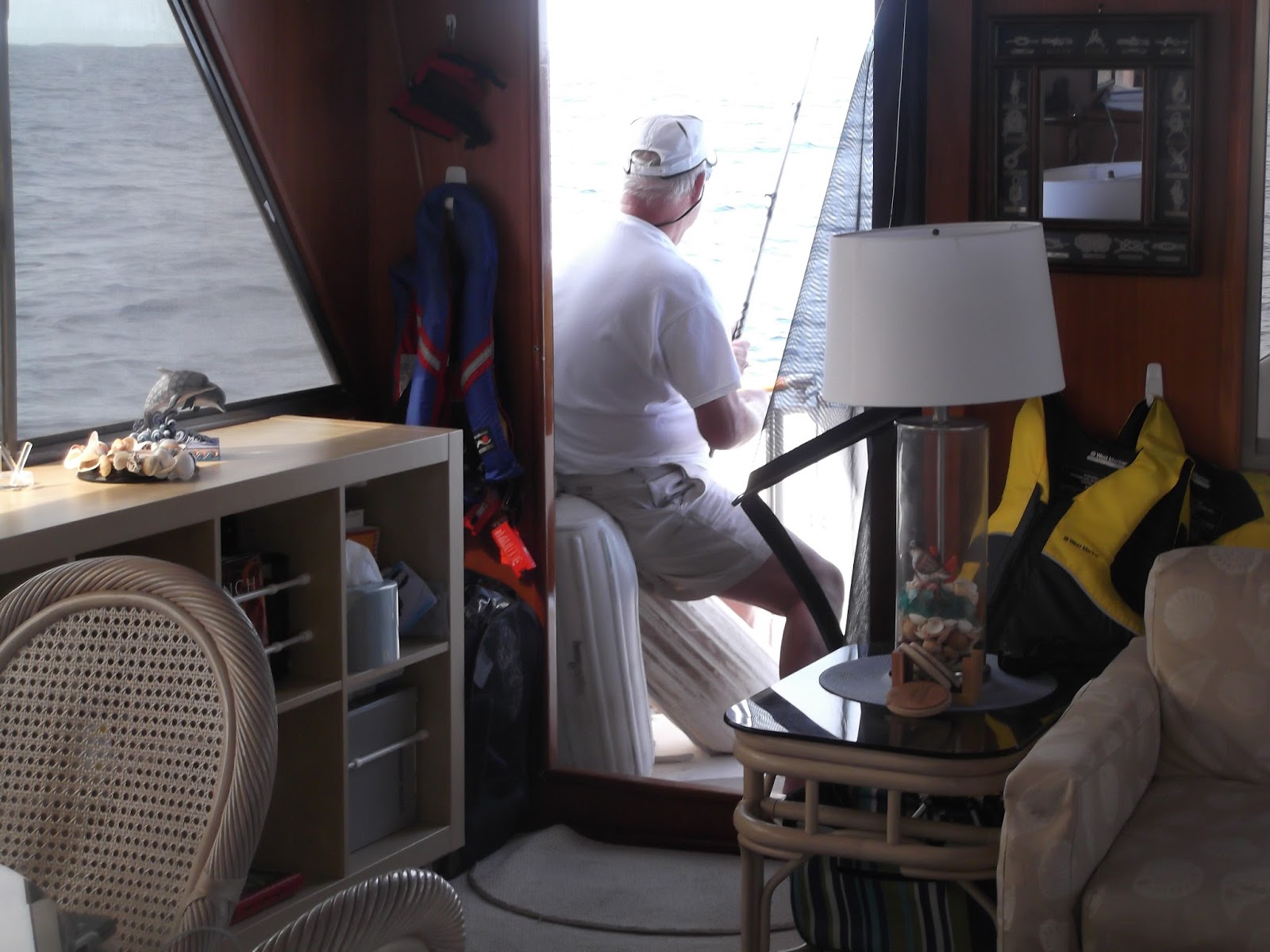
Our mission -- Space, the final frontier. These are the voyages of the starship Enter .. OOPS, sorry, I got carried away. Let me start again.

Our mission -- Warm Waters and Great Weather: The final frontier. These are the voyages of the Motor Vessel Traveling Soul. Its five-year mission: to explore strange warm waters, to seek out new forms of recreation and new civilizations, to boldly go where no Brown, Applegate or Higgins has gone before.

Wednesday, June 15, 2016

Up the ICW, 2016: Part Two

After Darien, we were off to Beaufort, SC. (Remember the “Beau” in Beaufort, SC is the same as the “beau” in beautiful; the “Beau” in Beaufort, NC is the same as “beau” as in somebody’s boyfriend.) Usually, we stay at the Lady’s Island Marina in Beaufort, but this time, we decided to try someplace else for a couple of reasons. First, our friends, Mark and Becky board Sea Angel were not going to be at the marina. Becky was having surgery and they were going to be at the hospital in Savannah at the time we were passing through Beaufort. We wish them well – and wish Becky  a speedy recovery. We hope to see them the next time we pass through Beaufort. The second reason we wanted to try Port Royal was that, to be honest, we did not have a particularly good experience at Lady’s Island last year.  The dockmaster made several promises to repair, or at least take a look at, our malfunctioning radio. None of these promises did he honor. (Eventually, we got the problem fixed, but it was not because of the dockmaster.) Moreover, last year Lady’s Island Marina just expanded the marina. Under normal circumstances that would have been a good thing – we like to see marinas that we enjoy grow their business. However, we got stuck in the “new” area that did not have cable TV (the rest of the marina did), that was well over ¼ mile from the office (so anything you wanted required a hike), that was located away from the other transients visiting the marina (so we couldn’t meet new people), and whose state of repair was generally below par.
The Port Royal Marina was generally nice except for two little problems: (1) The wi-fi was pretty bad, and (2) it was RIGHT next to a major highway bridge – so we heard highway noises all night. That particular problem we solved by closing the windows and turning on the air conditioning, even though it wasn’t that hot. At least the A/C generated white noise that let us sleep!

Actually, there is quite a bit of history associated with the region. European history of the Port Royal region began in 1514 – over 500 years ago – when Spanish Captain Pedro de Salaza explored the area. His was the second expedition that landed on the North American continent, after that of Ponce de Leon who landed a year earlier. Moreover, Port Royal was the home of the first fort in North America; later, nearby St. Helena served as the first capital for Spanish interests in America. Sixteenth Century America is turning out to be a fascinating interplay of Britain, France, Spain and plenty of non-state actors in the form of pirates. Even more interesting is that much of it took place in the Southeastern United States along the coast and the banks of the major river systems – much of which is now the ICW. We may have to spend some more time around Beaufort next year exploring more of its history.
After Beaufort, we headed north. We bypassed Charleston this year and went on to McClellanville, SC. Now, McClellanville has special significance for me. For the five years we have been cruising the ICW (and I am sure for many years before that) the area around the town has been one of the ICW’s “trouble spots,” in that it the water around the town was VERY shallow. The Corps of Engineers (with local assistance) is supposed to keep the waterway at 10’, more or less, all the time. But around McClellanville, it was frequently closer to four or five feet. Virtually all sailboats had to play the tides and even boats like ours had to be very careful. In fact, yes, we did go aground outside of McClellanville one time, and we have touched bottom a couple of others. So, every time we passed the place I had to ask myself, “Why in the name of heaven would anyone want to go to a marina in a town that does not lobby its local and state representatives to dredge the waterway in the region?” And I was serious. I, for one, refused – as a matter of principle – to use the McClellanville marina.

Lo and behold, last year the local government put up some money, which, in turn, pressured the state to put up some money, which, when coupled with cash from the Corps of Engineers, was enough to dredge the waterway!!! Well, that being the case, we did not have any choice other but to dock at McClellanville’s marina. It was a first for us, and quite frankly could well be a last in that it isn’t much of a marina. I will say, however, that there are three things about the area that we really enjoyed. First, the local restaurant was pretty darn good! It wasn’t anything fancy, but served plain old fashioned southern country seafood – and it was down home good! Second, the town has a live oak tree that is estimated to be over 1000 years old. Think about it: the tree was nearly 500 years old when Columbus landed; over 850 at the end of the Civil War.  Wow! And finally, McClellanville  has one of those small local museums that are a treasure trove of information about the area and have really some cool local artifacts. Unfortunately, we were only able to spend an hour before it closed. IF we ever go back to McClellanville it will be to see the museum (and probably to eat at the restaurant) not to survive the local marina.
After McClellanville, it was on to Osprey Marina. We didn’t spend the night there, we only bought fuel. Although it was well under my $2.00 goal, it was 1.81 – still a little high if you ask me. After Osprey, we stopped at Barefoot Landing Marina in Myrtle Beach, SC where we looked at some of the T-shirt shops, etc.

Last year we had intended to stop at Carolina Beach to set up on their mooring balls and check out the area. Unfortunately, we got pre-empted by Tropical Storm Ana and had to go to a marina where we could wait out the storm. This year, we decided, once again, to give the mooring balls a try. The mooring field was quite good and the balls themselves well taken care of, so we downloaded the dinghy and headed into town. On the one hand, the town has definitely seen better days as there were night clubs and bars on the ocean right next to ice cream shops (the ice cream shops were still closed for the season, the bars were all open – regardless of the season). On the other hand, the town was trying to comeback by building a nice little boardwalk near the beach. I am sure it is a lot nicer in the summer when families are enjoying the area and the beaches, but in mid-April, it was kinda dead.
A few miles up the Cape Fear River from Carolina Beach is Wilmington, NC. Last year, at the Annapolis Boat Show, we received an offer of a free three-day stay at xxx Marina. The problem with the marina is that it is across the bridge and about two miles from downtown Wilmington. I now, I know, you are wondering why we didn’t just hop in the car and go downtown – well, of course, we don’t have a car. What we did do was meet with our daughter, Lisa’s, best friend from high school (yes, that was a few years ago). Beky took Ann out to run a few errands and catch up on times past. And yes, Lisa, we now know more about your high school years than you would care for us to know! Overall, Wilmington seemed like a nice town. We did not get to take advantage of its sights as the marina where we stayed was just too far from downtown. If we go again – and we might – we will be staying at the city docks which are right on the local waterfront. 

Every year that we travel the ICW -- whether going up or coming down – we stop at Belhaven, NC. You are probably thinking that it is the birthplace of a famous author, philosopher or scientist to whom we want to pay homage, or that there is some sort of religious significance attached to Belhaven. Nope. It’s food. Spoon River Artworks and Market, believe it or not, is is a restaurant in downtown Belhaven that invariably has one or more extraordinary dishes made of local fare that would contend with some of the high end restaurants at which we have eaten in New York and Washington, DC. This year we started with a Quail Egg Brochette as an appetizer. Ann then had a Cornish game hen with potatoes and something else while I had seafood paella with lobster, scallops and shrimp. Everything was scrumptious!!! Often we anchor out when we go to the restaurant because Belhaven has a very nice anchorage. This year, however, we tried a new marina, the River Forest Marina, which is just out of town. The docks were adequate and we met several people we would not otherwise have met. We’ll have to wait until next year to see if we return to River Forest – but I can guarantee we will visit Spoon River!!
After Belhaven it was on to Elizabeth City. Elizabeth City, NC bills itself as “The Harbor of Hospitality.” Although we have been treated hospitably almost everywhere we have gone, in Elizabeth City they held an event, hosted by the mayor, with free wine and where they gave each of the ladies present a rose from the City. Moreover, the city has about 14 slips that are free to transients and several other locations on the waterfront offer free dockage. In short, Elizabeth City certainly is one of the most hospitable places we have been.

We went to Elizabeth City so see one of my West Point classmates and company-mates, Dick Atha. Dick was the quarterback of the football team back in the days when Army actually beat Navy once in a while. It was great catching up with Dick and getting his perspective on why Army football has been so poor over the past decade or so.
In addition to being the city where Dick Atha lives, Elizabeth City is also the gateway to the Dismal Swamp Canal. As the US Fish and Wildlife Service points out:

Human occupation of the Great Dismal Swamp area dates back some 13,000 years, 4,000 years before the formation of the swamp began. By the time European colonists arrived, the area had acquired its swamp-like character and it was here that they met the Nansemond Indians, who inhabited the western edge of the swamp.

In 1728, William Byrd II, charged with surveying the boundary between Virginia and North Carolina, proposed draining the swamp, selling the timber, and using the land for agricultural purposes. It would be 40 years before several prominent Virginians, including George Washington, founded the Dismal Swamp Land Company in an effort to implement Byrd's plan. The company did not succeed with the agricultural venture, but commercial harvesting of the swamp's resources had begun.

In the 18th and early 19th centuries, the Great Dismal Swamp served as a refuge for African-Americans escaping slavery. Historians believe these people established maroon communities in the swamp and used the swamp as both temporary and long term shelter. Henry Wadsworth Longfellow and Harriet Beecher Stowe found literary inspiration in the swamp and the slaves hiding there.
We had completed the canal once before. It was fairly shallow back then and remains so to this day. We probably won’t be going on it again as we touched bottom several times and for a short period of time even had something we picked up off the bottom (vine? fishing line? someone’s rope? Give the boat a vibration. I thought we were going to have to find a diver to take it off, but luckily it seemed to work its own way off the prop after a ½ hour or so. The Canal is fun, its kitschy, it’s interesting, but it also isn’t for us.

And that’s how we finished the ICW. On our next iteration, I’ll talk a little about our trip to Cape Charles, to the Solomons, and our projected maintenance – oh yea, and our new condo.
Ann’s Notes: I know Michael wants to get this blog out…I did read it and I think it is good to go.

Just one addition, when we had dinner in Belhaven and having dinner we were with another cruising couple. Kay and Charlie from Plane 2 Sea, we have met them several times at several different locations – and almost all included food. They are a fun couple to spend time with.
We have so much to do… My mind is working in a forward time span right now. Thinking back on the ICW cruise seems like a long time ago, I loved it and had a wonderful time.

Thank you for reading…our adventure continues…
Traveling Soul…OUT

Oh wait…Spot is happy and well… and took her first unauthorized swim. More on that later…

Thursday, May 12, 2016

Up the ICW: Stage One

We arrived in Palm Beach on 18 March and stayed for just over two weeks. We stayed primarily because we really like the area. We (meaning me) like the weather and the number of places we can go to get inexpensive boat supplies. We also (meaning Ann) know the malls, the grocery stores, the Targets, the Bed, Bath and Beyonds, etc. We generally stay at Old Port Cove Marina. They have a decent monthly rate and the ladies there have come to know us as well as we know them. We have already made reservations for next December when we plan on heading down and leaving the boat for a month or so while we go back home for Christmas.

When we arrived at the marina, they put us right in front of the restaurant. Now, this isn’t the fanciest of restaurants, but it is a nice one and we wanted to put our best foot forward. Unfortunately, all the boats next to us were not used by the owners very much were spic-and-span. And there was Traveling Soul who looked like she had been “rode hard and put away wet.” We had cleaned her once in the Bahamas, but since then she had cruised through many miles of salt spray, been used to catch fish, had been south of the tropic of cancer and generally had a coat of grease and grime on her. So, you are thinking that the first thing we did was give her a good-old-fashioned cleaning, right? Nope, not this time; this time we PAID for her to get a good-old-fashioned cleaning. The cleaners did not do as good of a job as Ann and I would have, but at least we weren’t embarrassed to have Traveling Soul right outside the restaurant.

Before going on, I should probably finish the saga of the watermaker. Now you are probably thinking, “Why is he such a cheapskate? If they need a new watermaker, why don’t they just buy one?” Well, I have a pretty good reason … actually, I have about six thousand good reasons; that’s right, six boat units; six grand, six thou, six Grover Clevelands – in short a boatload of money. I had decided that if we could get the old one fixed for about two grand that we would do it; otherwise, it would be a new one.

The repairman, John, decided that it might be the membrane assembly, so he took it back to the shop, tested it and everything worked well. If it wasn’t the membrane, then it might be the high pressure pump. It was going to cost some serious money to rebuild it, but that was John’s next best guess. He rebuilt it and it, too, seemed to be working on the shop bench. Well if it wasn’t the pump and it wasn’t the membrane, then maybe some air was getting in the fittings between the thru-hull and the pump. He replaced most of those and tried again. It still wasn’t working. Finally, because he was at a total loss as to what to try, he called his boss. His boss suggested that he take the pre-filter out of the system and see how it ran that way. John was convinced that wasn’t going to work, but since he had his boss on “speaker” when the suggestion was made, he felt he had to try it. You know what happened. It worked perfectly. 

Sometimes Spot just wants to
relax -- even when the
boat is underway
I have to explain. The pre-filter is one of those little paper accordion filters that you might use on your hose. You can buy them in various sizes, from 5 microns thought, at least, 30 microns. When you put a 5 micron pre-filter on a system that really needs 30 microns, the filter clogs up and water can’t get through. Now, most modern watermakers are made to exacting specifications and have low tolerances – thus, John thought we needed a 5 micron pre-filter. As soon as we figured out that it really needed a 30 micron filter it became pretty obvious – older watermakers did not have the same exacting specifications as newer ones. Our 30 year old pump could easily handle 5 – 30 micron impurities, what it could not handle was a clogged filter that would not let water through. What is that old saw? “For want of a nail, a shoe was lost …” In our case, for want of a *&&*()8^$@ 30 micron paper filter, 2 Boat Units were dropped. AARRGGHH!!!

After re-provisioning in Palm Beach and getting re-accustomed to the land of big grocery stores and cable TV, we made some repairs and improvements to our internet connectivity. First, we replaced our wireless router. Our old router just wasn’t putting out much of signal anymore. We couldn’t get it at the printer, just one deck below the router, and couldn’t get it at the salon table (where we do most of our computing), so we replaced it with an inexpensive NETGEAR router. Additionally, our Verizon aircard (technically, I think it was a wireless modem) was not working as well as it once did, so we replaced it with a Verizon Jetpack. With those two modifications, we are now up and can be on-line most of the time.

Two weeks and four days later, we had formulated our campaign plan for heading up the ICW. We decided we would:
·         Control costs by

o   Anchoring as much as we could

o   Take on fuel only at the least expensive locations along the waterway

·         Visit some specific locations, including

·         Visit targets of opportunity along the way

·         Arrive in Solomons, MD on or about 5 June
And then we were off. Our first stop was at the Loggerhead Marina at Vero Beach, primarily because they have good fuel prices. It worked out to $2.03 per gallon – a little higher than my $2 goal, but the best we could find in southern Florida. As it turns out, in the slip next to us there was a retired Army officer, Carol Doyle and his wife Roberta who live aboard their boat Miramare who said there were three others retired Army officers in the marina. We had a drink and lot of fun with them. We’ll try to see them again next year.

After Vero it was off to see our friends Tom and Cristina aboard their boat Tadhana. We like Tom and Cristina and we like Cocoa Beach where they were staying. We met for lunch at Ryans – which has the best “white” pizza we have had in a long time. In addition, Cocoa also has the biggest hardware store I have ever seen; it occupies seven buildings in the historic district. Needless to say, we always go there with a list of stuff we need to buy.

We then took two days to get up to Saint Augustine and stayed on a mooring ball there for three nights. Why Saint Augustine? Because it is just about our favorite city on the ICW. We have been here three or four times and every time we see and learn more about the city. This time we visited a for-profit “Archaeological Park” that actually had a number of interesting exhibits. Did you know, for example, that Ponce de Leon (of "fountain of youth" fame) was on Columbus’ second voyage? And that Ponce was the first European to set foot on the continent of North America -- despite what any of those Limeys may tell you? Ann went to see Flagler College. Did you know there are 79 Lewis Comfort Tiffany windows in the college’s dining room? There are other places we still have to visit. Next time I really want to go to the Ripley’s “Believe it 0r Not” Museum .

The dining room at Flagler College.
It used to be the dining room at Flagler's
 "Ponce de Leon" Hotel.
After Saint Augustine our plan was to proceed up the coast to Cumberland Island. As is the case with most of these places, we have been here before and just love the place. It combines elements of history with nature in combinations that are difficult to describe and always interesting. However, the closer we got to Cumberland the worse the weather sounded, and since we would have been anchoring at Cumberland we decided to skip this particular island and head to our next destination, Jekyll Island.

We have written about Jekyll in the past. Although the weather was as forecast (terrible for the first several days), we did manage to accomplish one goal we did not achieve last year. We saw an alligator in the wild! Actually, we saw two of them. One was about 5 feet long and no more than fifteen feet or so away from us. The other was on the other side of the pond and was about 12 feet long. We also took the tour of the cottages, ate at the Rah Bar. We also went to the Crane Cottage for lunch with our friends Kay and Charlie from Plane2Sea. We also bicycled, shopped (well, actually, Ann shopped), and took the marina’s golf cart to the grocery store.

After Jekyll we made a short stop at Brunswick Landing Marina for diesel. It costs (are you ready for this?)  One Dollar and Sixty-Five cents per gallon. Now, this won’t mean anything to those of you who don’t cruise the waterway, but Sheri was fired. Now Sheri was an institution at Brunswick Landing. She was built like a football player, had the mouth of a sailor and had two dispositions. If she liked you, she was a real sweetheart; if she didn’t she could be a real (witch – w + b) – if you get my drift. Since Sheri liked us (actually, she liked Ann and tolerated me), we sometimes stayed at Brunswick to make sure we stayed on Sheri’s good side.

The blockhouse at Fort King George in Darien, GA
After Brunswick, we went to Darien, GA. Darien has a free dock where you can moor your boat for up to two nights. We had wanted to go last year, but when we were ready the town was in the midst of their annual blessing of the shrimp fleet. Apparently it is quite a shindig in that there were no slips available.  We went there this year with three items of significance. First, we visited Fort King George, a state historic site. From 1721 until 1736, Fort King George was the southern outpost of the British Empire in North America. A cypress blockhouse, barracks and a palisade earthen fort were constructed in 1721. For the next seven years, His Majesty’s Independent Company garrisoned the fort. They endured incredible hardships from disease, threats of Spanish and Indian attacks, and the harsh, unfamiliar coastal environment. After the fort was abandoned, General James Oglethorpe brought Scottish Highlanders to the site in 1736. The settlement, called Darien, eventually became a foremost export center of lumber until 1925.

Second, we bought two pounds of just-off-the-boat shrimp! That evening we cooked them on the grill and loved them. Third, though we did enjoy the stay at a free dock, we scratched the hull pretty badly. I am sure that it will cost us a couple hundred bucks to get it fixed – a little more than a slip would have cost. It just goes to show …

It is absolutely impossible to capture via photo or in words the stark beauty of the Georgian marshlands. Imagine this view 360 degrees around you. It is really cool.
In just a minute we are going to close out this entry. But before we do, I want to say something about the anchorages where we have stopped. You will note that we have discussed only those locations where we had something specific to do, or those marinas about which we had something specific to say. We have not discussed the many anchorages that lie in between. I love anchoring and I can honestly say that I enjoyed almost all the anchorages at which we stayed. There are a number of reasons. First, we get to sit back and enjoy nature. One of our anchorages this year was in an ancient cedar swamp; another was in the marsh lands of southern Georgia and yet another was among the abandoned rice fields of South Carolina. Trying to describe the surroundings of these anchorages is nearly impossible. All of them are, in their own way, marvelous. From many of them you can see for miles in any direction and not see a soul. Imagine sitting on our flybridge on a beautiful 75 degree day, with a nice, cool drink in one hand, barbecuing freshly-caught shrimp with the other and listening to some groovy (yes, I did use that word!) tunes from the 1960’s on satellite radio. Although each anchorage is different, the “chillaxed” feeling you get from anchoring on almost any one of them is absolutely wonderful.

Ann’s Notes: I know you must be surprised seeing me put my two cents in..I know I skipped the last blog. I did proof read the last one and Michael writes and described the events so well I had nothing to really add.

Our stay at Old Port Cove, as usual was nice. I really do like the Palm Beach area and I do know my way around. Plus Spot’s vet is there so she got her annual shots and check up. She is fully grown, on the small side for a cat, she only weighs ten pounds. Her personality which is larger makes up for her smaller size. She is the perfect boat cat, I am so glad she is part of our lives.

While we were in Palm Springs we replaced the anchor chain. Our old chain was yucky and rusting. One would think in a boating community that replacing  220 feet of chain would not be a problem. Oh…not so fast matey…it was a two day project on the phone finding the correct size of chain for the windlass and the length needed. As it turned out …West Marine had to special order it …once ordered we had to pick it up in the rental car. We always get the economy size car from Enterprise, so needless to say it is on the smaller side. Now 220 feet of rolled up chain weighs about 330 pounds. I know this because I Googled it. 3/8 chain weighs about 1.5 pounds per foot…I did the math for you. Michael and I had to handle lots of chain. Remember we had to get the old chain off the boat and put the new one on, that involved taking Bertha off the end of the old chain. Let us just say it became a two day project with lots of chain moving. Gotta love cruising to do all this.

Our trip up the ICW has been wonderful. The weather has pretty much been good, a little on the cool side. That just makes sleeping at night much more pleasant. The bugs that love me and leave makers are still plentiful but I have enough anti bug stuff on board to counter act those nasty insects.

I saw one thing in a little southern country store in Darien GA. They were selling local honey, I picked up the bottle to see where the honey was from and what types of plants the bees used to make the honey. The type of plants will give the honey a distinctive taste. So I am reading the label and I start to giggle..on the bottle; it read, “our bees are all free range bees” I guess it is hard to keep bees from not wandering off.

Traveling Soul…OUT

Wednesday, April 27, 2016

Long Island and the Bahamas

After letting Dave and Joan off in George Town, we stayed in the area for a few days so we could rest, recuperate and re-provision. Now George Town is a busy place. There are usually about 300 boats at anchor in the Harbor and a “Cruiser’s Net” every morning (on VHF channel 68) to tell resident cruisers what is going on and where. Since we were there during the preparation and run-up to the Annual Cruiser’s Regatta, there was more activity and radio traffic than usual – a lot more. Now, Ann and I think Regattas are fine, but when they are stretched out over a week and there are only one or two regatta events per day (in none of which we are participating), the constant radio traffic can get a little tiring. So, since we really had nothing to do with the regatta, we decided that we would leave George Town the day it started and move on to Long Island!!

This year, one of our goals was to go further east and further south than we had gone before (kind of like the personnel of the Starship Enterprise: we wanted “to go where no Brown had gone before.”) When we reached Long Island we had succeeded. We were beyond the Tropic of Cancer; we were in unexplored regions! Long Island held three adventures for us. Let’s just call them … the Good … the Bad … and the Ugly.

The Good

This sign marks the Tropic of Cancer
We arrived in Thompson’s Bay, Long Island on 27 Feb. Thompson’s Bay is a pretty good anchorage; it has excellent protection from the east and north, some protection from the south and a even reasonable amount of protection from the west. True, you would have to move around a little if the wind got overly rambunctious, but while we were there, it generally behaved itself. Thompson Bay is a popular anchorage. When we arrived there were about fifteen other boats already there – many, like us, were refugees from the regatta. Fifteen boats may seem like a lot, but the Bay is very big and could hold many times that number, plus we had just left George Town with 300 boats at anchor. To be in an anchorage with only 15 boats was like a dream.

Thomson Bay abuts the settlement of Salt Pond, which is almost exactly half way down the island. That’s important because the southern half, everything below Salt Pond, was devastated by last year’s Hurricane Joaquin. Many of the cruisers in Thompson’s Bay are frequent and long time visitors to Long Island and, while we were there, had one or more projects on-going to assist in the island’s recovery. I will say – even though I probably shouldn’t – that the cruisers seemed to be doing more for the island’s infrastructure than the local residents were. Jus’ sayin’.


Long Island is … well … long. It is about 80 miles long and 4 miles wide at its widest point. It is about 230 sq mi. in area and it is located 165 miles southeast of Nassau. The Tropic of Cancer runs through the northern quarter of the island. Its original inhabitants, the Lucayan Indians, called it “Yuma.” Most historians and archaeologists believe that Columbus visited the island on his first voyage (1492) after stopping at San Salvador and Rum Cay. It was then that he rechristened the island “Fernandina” after King Ferdinand. After the Spanish rounded up all the Lucayans and took them to Hispaniola and Cuba to serve as slaves, there was no large settlement of anyone until the arrival of the Loyalists during and after the American Revolution.

The original Loyalists were mainly from New England and New Jersey arrived on Long Island after fleeing the American Revolution. These families started the first farms, raising primarily cattle and sheep. By the 1790s, settlers began to arrive from the Carolinas and proceeded to set up cotton plantations. The plantations flourished for only a few years and, by the time of the abolition of slavery in the Bahamas in 1834, most had collapsed and been abandoned. There are many ruins from this era today, none of which have been taken care of, and the majority are overgrown by bush.

Friends had suggested that the best way to see the island was to rent a car for two days. On day one, they suggested, we go south and on day two, north -- that way we would be able to see most of the island in the most efficient way possible. We rented a car and headed south. There were three highlights to the trip south.


Sixteenth century Spanish mission
located on the side of the road.
The first was a 16th century Spanish mission. Now, in the States, if there were a 16th century church there would be signs pointing to it off the highway, signs explaining what you were seeing and either the local Catholic Church or a volunteer association would raise money for the site. In the Bahamas, by contrast, you have to keep your eyes open as you drive down the highway, otherwise you would miss what looks like a derelict building just off the only highway on the island. I have no doubt that a serious archeological effort could lead to some interesting results, but I am not sure one has ever been attempted and there are few signs that anyone is seriously interested. The second highlight on our trip south was “Dean’s Blue Hole.” Dean’s is a 600 feet deep hole in the island that is filled with sea water. It is about twice as deep as most other blue holes in the Bahamas and elsewhere. Dean’s is famous as the location of several free-diving world records and was the host of the 2009 free-diving championships. It is really kind of cool! The third highlight was the Flying Fish Marina in Clarence Town. It was modern, had a really good bar and grill attached, and looked to be a first class marina


This is Dean's Blue Hole. At the swimming platform,
it goes 600 feet straight down.
After Clarence Town, however, it did not look as if there was going to be much to see further south. So, while we drove another thirty or so miles, we eventually turned around and headed north. Although our goal was to see the Columbus monument at the northern tip of the island (about which, more later) we only went as far as the Tomb and grave marker of Louisa Morris, the daughter of John Morris, plantation owner and slave holder in the late 19th Century. The grave marker had apparently been stolen in 1999, but since then had been returned to the Bahamas. The Bahamian government built a nice little monument to the Morris’, though it is way back in the bush!

By this time we were kind of getting tired of driving and headed back to Salt Pond to turn the car back in.

The Bad

You may recall that we had been having trouble with our watermaker for several weeks. After I replaced the membrane at Staniel Cay, it worked fine. While Dave and Joan were visiting it worked okay initially, but after a week or so, it started misbehaving again; it would run for about an hour, then turn off. We could still produce water, it was just a slower process. As time went on, though, the length of time between failures constantly decreased. By the time we got to Thompson Bay, it was only running for about ten minutes before the alarm went off and we had to turn it off. Hmmmm. This was not good.

We decided we would go to the nearest marina, Stella Maris Marina in northern Long Island. There, I would take apart the watermaker to see if I could fix it. (I wasn’t overly hopeful, but I had replaced the membrane – and maybe, just maybe, I hadn’t replaced all the fittings correctly. If that were the case, I might, indeed, be able to repair it). Even if we couldn’t get it fixed, we figured, we could fill up with water at the marina and then decide what to do.

Spot pointing out an error I was making in
Watermaker repair
Stella Maris was a marina in name only. I reviewed it in Active Captain (kind of like a “Trip Advisor” for the cruising crowd) and wasn’t very kind. All of that aside, our immediate problem was that I could not fix the watermaker AND they did not have reverse osmosis water – they used cistern water. We are very particular about what goes into our water tanks and salty-tasting cistern water wasn’t going in.   

When I was in the Army there were times when we would get a couple of quarts of water per day – and it was for drinking only. You could use it for teeth-brushing or shaving if you had to, but that came out of your drinking stock. We didn’t shower and didn’t wash our clothes. We ate out of cans and licked our plastic spoons clean. We seldom cooked anything with water and certainly didn’t have ice for happy hour. In short, I know how little water a person really needs. We also know that there are some purist sailors who guard their water almost as jealously as infantrymen. They bathe and wash dishes in salt water and use fresh water for cooking only when necessary. Given all this, I know that it is absolutely true that if you put your mind to it, are willing to stink to high heaven, to taste salt in everything, to eat out of cans and never to wash your clothes, that you can save enormous amounts of water. However, I am now just a little older than I was in my twenties and am used to a certain style of living, e.g. occasional showers, plenty of drinking water, well-cooked meals, clean dishes and, oh yea, ice for my 5 PM cocktails.

Still, Ann and I are pretty good at rationing water and can easily live – and live well – with twenty gallons per day and even less of we had to. However, at Stella Maris we had only about 75 gallons in our tanks (our tanks can carry about 200). Moreover, there are very few marinas in the outer islands of the Bahamas. So, while we could certainly explore the rest of the islands we wanted to see, we would be constantly tethered to some very specific marinas – those that had good water. So, we decided that our broken watermaker was a sign that we should turn back – so we did.

From Stella Maris we headed north to Cape Santa Maria (which has a beautiful resort and beach, by the way), then back to Emerald Bay Marina to get some water and to wait for a weather window so we could go north and start the trip back to the good old USA. After Emerald bay, we stopped at White Point, Black Point, Norman Cay and Highbourne. It was on this trip, from Emerald Bay to White  Point that we caught a Black Fin Tuna! It was only about 14-15 inches long (about two meals)  and was relatively easy to clean. I will say, however, that we are still struggling with a  good recipe for black fin. Anyway, we stopped at White Point and most of the other islands to wait for weather so we could make the next leg of the journey, but we stopped at Highbourne because of the restaurant. It is as good as I remembered!

A blackfin tuna.
After Highbourne, it was on to Nassau. We only stayed a couple of days and only went downtown once. We have “been there and done that” several times in the past and didn’t think we needed to visit again. After Nassau, on the way to Chub Cay, I’ll be damned if we did not catch yet another mahi-mahi. We were much better at filleting the fish this time and were in an anchorage where we could throw the waste overboard.  In case you are counting this is mahi number two and fish number three. After a night at Chub, we were off to Bimini. Usually when we go to Bimini, we head to Brown’s marina -- for obvious reasons – then on to Fort Lauderdale. This time we decided that we wanted to go from Bimini to Palm Beach, which is a little over 100 miles. Even though we would have the Gulf Stream with us, we fissured we might want to leave before dawn. The channel into and out of Bimini can be a little complicated – especially at night – so we decided to anchor just off the northeastern tip of the island so we could get a good jump on the following day.

We have, of course, run the boat in the dark many times in the past. Nevertheless, it constantly amazes me how different night boating is from day boating. The night before we took off, I had examined the sea closely and there was nothing surprising; everything was on the charts and on the radar. Shortly after we left, however, at about 0400, I was sure I saw some lights about a mile out. What were they coming from? Was there a marker I had overlooked? Even worse, could there have been a shallow area close to our proposed route? I turned the boat to make sure we would not come close to whatever was out there and proceeded very cautiously. In the event, there were lights out there, but there were not a mile out, they were about five miles out; they were not buoys or markers, they were from another boat. Oh well, it was a little nerve-wracking, but not at all dangerous.
Mahi Number Two!
We then hit the open ocean and eventually the Gulf Stream. The stream propelled us 2 ½ to 3 knots faster than we would otherwise had gone. We arrived at Old Port Cove Marina at 1430, had a beer to celebrate the end of this Bahamian Adventure and our return to the land of the free and the home of the brave!

Then, we started planning the trip northward on the Intracoastal Waterway.

The Ugly

Actually, there was no ugly … it just sounds so much better than saying there was good and bad J

Saturday, March 5, 2016

Dave and Joan's Visit


From 7 – 20 February our friends Dave and Joan Wolf visited us from the great State of Virginia. During that time they experienced all the ups and downs of cruising. While they were here:

·         We hid from the weather, once from west winds and once from a 30 knot easterly blow.

·         We enjoyed the heat (it was snowing back in VA), and almost froze to death (it got down to 70 degrees F one day). Brrrrr!

·         We learned that one definition of cruising (the opportunity to repair boats in exotic locations) is entirely true as we broke, fixed, re-broke and re-fixed our generator.

·         We stayed at a couple of lovely, single-boat anchorages and later joined 300 of our best (?) friends in the massive anchorage at George Town, Bahamas.

·         We ate at two different yacht clubs, two beach bars and on one boat with a magnificently-equipped galley (ours).

·         We almost … almost … almost caught a fish.

Let me expand a little on each of these themes.

First, Dave and Joan flew into the airport at George Town, Exuma, Bahamas and took a taxi to the marina where we were staying at Emerald Bay. The reason we were at Emerald Bay in the first place was because there had been some not-so-bad-but-not-so-good weather for the latter half of the previous week. We had decided on Thursday to wait at the marina until Dave and Joan arrived so we could decide when to head north. We were lucky that we were at a marina, and that the marina was as fancy-schmancy as the Emerald Bay property, because they arrived on SUPER BOWL Sunday. We, and of course just about everyone else in the marina, had to go to the Super Bowl Party in the very well-appointed Captain’s Lounge. We heard that some people even stayed for the whole game. As for the four of us, we only made it to halftime. Then, both we – who normally go to bed shortly after 2100 – and our guests – who had been up since 0300 to catch their flight – continued to virtually cheer for Denver while we got some rest.

We waited out the weather on Monday and decided to head out on Tuesday. Well, I can tell you it was a little bumpier than I had thought it would be. Now, Dave and Joan are boaters and have been boating with us before, both on our co-owned boats on the Chesapeake and on visits down here to the Bahamas, so they weren’t put off by the sea state, it was just bumpier than I would have liked for their first day on Traveling Soul. Actually, it wasn’t that bad for the first hour or so, then deteriorated rapidly. In fact, while we had planned to make nearly 60 miles that day (a bit ambitious, in any event), we decided to stop a little early, near Staniel Cay. 

Since we expected a little westerly wind that evening, we spent the night in our favorite west-wind area, Big Rock Anchorage. While there, we went to the Staniel Cay grocery store, which Dave and Joan can attest is about the size of a 7-11 and has even fewer groceries. We also went to the Staniel Cay Yacht Club which, on its walls, has a number of pictures of – are you ready for this – the cast and crew of Thunderball, the James Bond film that many of you will recall was filmed in the Bahamas. In fact, we really wanted to get Joan (she is the real snorkeler) to the grotto where the famous concluding underwater fight scene was held. Unfortunately, the weather just wouldn’t cooperate. It was actually BELOW 70 degrees. Brrr.

We ended up staying at big Rock for two days, waiting decent winds. When they arrived on Thursday morning, we went to one of Ann and my favorite anchorages, just off the northern tip of Bitter Guana Cay. It is a picture perfect anchorage with beaches to behold, paths to walk, hills to explore and even local iguana to admire – or to run from, if one starts after you as happened to Dave and me.  The last time we were here, we were the only boat in the area. This time we had company from four or five additional boats. Most of them were fairly polite, so it wasn’t too bad even with the interlopers. Harumph!

The next day it was off to what I believe is one of the most picturesque locations in the Bahamas. We stayed at a mooring ball in the Exumas Land and Sea Park; but rather than being in a mooring field, the ball is a single mooring with no others around it. I think we took pictures, but you have to realize that pictures don’t do it justice as the scenery is dazzling in every direction. I know there are some cameras that can capture a panorama, but the view at Obrien’s Cay is just magnificent. Also the mooring is right next to an island owned by our own Pirate of the Caribbean, Captain Jack Sparrow (Johnny Depp). After sitting in the flybridge, enjoying the scenery and listening to our satellite radio, we decided to get the dinghy down and go explore the Sea Aquarium, a well-known and wonderful local snorkeling spot. Just as we started lowering the dinghy, however, it happened – the generator conked out. We tried starting it again. Nothing. And again. Nothing. And again … I think you get the picture.
Eventually, Joan did get to go swimming. Here is proof!

I did everything I could think of doing. I replaced the start-up solenoid because the problem was similar to one we had several years ago. The new solenoid wasn’t the answer, so we started up the main engines for an hour or so to keep the refrigeration running and the lights on. The next time we tried to start the generator, I noticed, that the engine appeared to be overheating. I figured it could be the impeller, so I replaced that as well. (That was another story – replacing an impeller looks easy and probably is for folks who know what they are doing, but it certainly wasn’t for me. Anyway, I eventually got it done, but the damn generator still didn’t work.) While all of this was happening, I could still look out the hatch, though, and see the beauty surrounding us at Obrien Cay. It was then that I remembered the old saw that “cruising means repairing boats in exotic locations.” <Deep wistful sigh>

I was about ready to give up, but decided to call some friends of ours in the off chance they would be somewhere close to Traveling Soul and might be able to help. Now, you have to understand that cruisers generally like to help one another. Not only that, but sometimes they have to. When you are stuck in the middle of the Bahamas with no competent mechanics around, you have to go to your friends for assistance. Vic and Gigi aboard Salty Turtle are not only great cruisers and wonderful friends, but they would give you the shirt off their back if you needed it. And Vic, well, Vic is a pretty damn good mechanic, as it turns out. Well, as luck would have it, the next day Vic and Gigi were only going to be a relatively short distance from the marina where we were planning to stay.  

Mike (observing) and Vic (assisting) the
"Generator Whisperer" Scott (out of picture)
About an hour after we got to the marina, Vic arrived with his tools and went right to work. The first thing he did was put in the impeller properly. (I had made one slight, little mistake.) That was a major step in the right direction, but we still couldn’t get the generator to keep running. Vic then tried this, tried that and tried something else. Everything seemed to be functioning well, but the generator still wasn’t working.  Vic finally decided that he needed to get Scott – who, apparently, is the true expert on diesel engines and, to malfunctioning generators, the most feared human mechanic. Now, I don’t know Scott and have never met him. But remember what I said about cruisers in general? They really do want to help one another, so Vic was pretty sure he would be able to recruit Scott into our repair effort. Before she left, Gigi assured us that we would have a working generator before we left the area. The following day, we moved the boat to Big Major Spot and shortly thereafter Vic and Scott came riding to the rescue in Scott’s cool dinghy.

Now, lest you think that I was completely idle while awaiting Vic and Scott, I was not. In fact, I had been reading the manual when something struck me. [First a note: those of you who are not boaters might think that engines on boats are cooled with salt water; that is not exactly correct. Actually, they are cooled by FRESH water which circulates through the engine. The fresh water, in turn, is cooled by salt water that is scooped up and fed into the heat exchanger.] Everyone had focused on the sea water and the sea water – fresh water heat exchanger, but no one had looked at the fresh water itself. I went into the bilge, checked it, saw that it was low and added some more. I wish I would have had antifreeze to add to the water, but I didn’t have any on board – I never plan on being on a boat that is in freezing temperatures. Anyway, the engine started up and it looked like I might have solved the problem. I then decided to re-replace the solenoid since there was apparently nothing wrong with the one I had replaced the previous day. Oooops! Big mistake. By the time Scott showed up the generator was not working at all!

I think it took Scott all of half-an-hour to figure out that I had broken the generator, fixed it by adding the fresh water, then broken it again by incorrectly replacing the solenoid. He moved the one wire I had mis-connected and voila! The generator worked again!!! He and Vic were then off to help another cruiser with his engine. Scott, aboard his tricked out dinghy, reminds me of the Lone Ranger riding his horse Silver, which, of course, makes Vic his faithful companion Tonto (sorry, Vic, but sometimes I back myself into literary corners).

After our generator tribulations, we headed down to Little Farmer’s Cay. There, we had lunch at the Farmer’s Cay Yacht Club. It is kind of difficult to describe this particular Club. First, it is not like a yacht club that you might normally consider. It is a pretty beat up building that has a couple of rooms inside, one of which is empty and one looks like a 1960’s restaurant, with old tables, table cloths and variegated straight-back chairs, and two picnic tables outside. We ate outside as did the only other group at the Club.  The Bahamian serving us also either owned or managed the Club and had his other employee cooking. It took a while to get the food and it was very okay. So, why did we go? Because we wanted Dave and Joan to be able to say that they ate at multiple Yacht Clubs in the Bahamas, of course!

The following day we headed to George Town. On the way, we … yes, you guessed it … we (almost) caught another mahi! Don’t worry, I am not going to go into great detail. Let me just say that I hooked him and brought him within feet of the boat, where he proved to be very rambunctious. Although I tried to gaff him, he kept jumping and moving away from us. Finally, on his last jump, he was gone. I know exactly what I did wrong. I should have fought him longer and tired him out more. That way, we would not have had the energy to jump and we would have been able to get him on the boat. Lesson learned!
Dave and Joan at the "Chat and Chill"
 beach bar. They saw a sign on this post for
"Put-In Bay, Ohio," One of those cold places
they used to go.

After arriving in George Town, we anchored, went downtown, visited Chat and Chill (the local beach bar) and did some regular touristy-things. The day before Dave and Joan left for their return flight, we stayed at the Exuma Yacht Club – which is more of a marina than a yacht club – and had some excellent lobster quiche made by Ann.

 Ann’s Notes: Just wanted to fill in a few blanks…

The visit with Dave and Joan was fun, glad we can share some of this adventure with them. They know they are always welcome on board Traveling Soul. Plus Spot gets a lot more spoiled when they are around. Dave builds the best cat forts from pillows on the sofa. I have tried to duplicate the fort but Spot just thinks I am crazy and walks away after a big yawn and stretch.

Michael pointed out that while lowering the dinghy the generator stopped. Please note that at that point the dinghy is hanging over the side of the boat and I am up on the second deck holding on to a bow and stern line – and the hand holds on the dinghy. Standard procedure in lowering the dinghy…the bad part is that we need the generator to power the motor that makes the winch – and the cable on the winch – go up and down. The only good things about this incident are: the generator did start again, long enough to get the dinghy back on board AND there was very little wind while it was being deployed and I was handling it. Not too much panic on my part, just some silent prayers.

Joan did get to go swimming once, while we were at the Chat and Chill in Georgetown.

The four of us had a few wet dinghy rides, Dave and Joan saw what the local Bahamians call a grocery store. They range from a little building to massive ones; provisioning, has become an art form for me.

That is all for now, Thank you for following us.

Traveling Soul…OUT


Sunday, February 7, 2016

Fish On!!

About three days after Blowmagedon, there was yet another little wind storm for which we had to prepare. It wasn’t supposed to be as serious, but the winds were going to be out of the west, so we went back to Big Rock Anchorage.  This time, though, we were both surprised and chagrinned to find that there were a number of people joining us – there were at least eleven boats. Moreover, they all must have figured we had the best spot in the whole anchorage as they all came much closer to us than any of the boats did last time. Seriously, last time there were about seven boats spread throughout the anchorage. This time there were eleven boats in about half of the anchorage. And one of them … well I won’t go into detail, but let’s just say it was WAY too close. But this little wind event is not the story of this blog entry. The story of this blog entry is …
Are you ready? I mean are you sitting down? Are you really ready? Ok, here goes … I, with help from my first mate, caught a fish!!!!!!!!!!!!!!!!!!!!!!!!!!! A huge fish!!!!!!!!!!!!!!!!!!!!!!!!! And I (with help from one of our friends) filleted it!!!!!!!!!!!!!!!!!! And we are in the process of eating it!!!!!!!!!!!!!!!!!!!!!
The Story

There we were cruising down the Exuma Sound on our way to George Town without a care in the world. The weather was decent, but the seas were a little cantankerous, I am guessing 2 – 4 feet. We were trailing two lines, one from each of my rods. At the end of one was a green and yellow cedar plug, a well-known and effective lure when fishing for mahi-mahi. On the other line, I was using a pretty blue thing that had feathers on it; it looked a little different and I thought it might attract some kind of fish or another. I would check out the back periodically to make sure the lures were dancing at the end of the line and looked like the bait they were emulating; the cedar plug really looked like a wounded flying fish and the pretty blue thing looked like … a pretty blue thing skipping through the water. I wasn’t particularly anxious, I was just waiting. Then it happened.
Me in my "fighting chair" on the aft deck
The line started ripping off the reel as the fish launched into the deep blue. Ann shouted “Fish On!” I took the synchronizers off and put the boat at idle speed and headed aft. (Ok, Ok, you caught me. Ann didn’t exactly say “Fish on!” She said something like, “I think you have a fish,” But, come on, “fish on!” sounds better and more professional.) Anyway, after putting the boat at idle speed I turned over the helm to Ann, just as we had planned, and took the reel out of its holder, gave two good jerks to set the hook and started ever so slowly turning the drag up. As I was doing that … I swear … the line starting ripping out of the OTHER REEL!!! Oh My God, I had two fish on the line. Now, remember, before this I had never even caught one fish trolling from Traveling Soul. The first fish appeared to still be on the first reel, so I put it back in the rod holder and headed to the second one. I picked up the rod, gave two big jerks and started slowly ratcheting up the drag. Just then I noticed that the lines had crossed one another. Oh, oh. This was not good. It would be easy for the friction from the lines to break one or the other – or quite possibly both. I wasn’t quite sure what to do, so I kept trying to land the fish on the port side of the boat. It didn’t seem that hard as he didn’t seem to be fighting that much. I brought him to within sixty or seventy feet of the boat and finally saw color (that is what we fishermen say when we can see, what in this case was a magnificent swash of green, in the water). It was at this point, when he was five or so feet deep and sixty feet from the back of the boat that he decided he didn’t want to come to dinner after all. He took off as only a big-honkin’ fish can, and started taking line again. Lots of line. It was then that two things happened simultaneously. First, I saw the line from the starboard reel go completely limp and start fluttering in the breeze. At the same instant, I felt my line go limp as well.

Now it is possible that I hooked only one fish and that he got tangled in the second line, so when I lost “my” fish, both lines went limp at the same time. It is possible. But I would have sworn that for a few seconds there, I had two good sized fish on the line and that it was only a matter of deciding which one I would bring on deck first.

But I lost them. I was convinced that the story would end there. That’s okay, I thought, it would be a nice blog entry. Not the same as landing one, of course, but what the hell. Each time I hook a fish I am getting a little bit closer to putting him on deck. I knew that hooking a decent-sized fish, let alone two, was not a commonplace occurrence and I figured that had just lost my chance for the day. Oh Well. I sat and tried to figure out what I should do and finally decided that the only way to guarantee I would not catch a fish today was not to put a line in the water. So I dropped another cedar plug in and let it drift until it was about 200 feet behind the boat. OMG, thirty minutes later, it happened again. “Fish on!” (Ann didn’t say it this time either, but I knew that is what she was thinking!)

Again, I turned the synchronizers off, set the boat to idle, turned the helm over to Ann and headed to the aft deck. I sat on the pile of fenders that I used as my “fighting chair” (so I don’t fall off in bumpy seas) and began going through my process. Two big jerks to set the hook, let him run a little further, then   slowly start to increase the drag. So far so good; I still had the fish. At that point it became a bit of a waiting game. He kept pressure on the line and I held the rod in place. I had 30# test on the reel and I would say that he was putting just about that much pressure on the line. For the next twenty minutes or so, all I could do was hold on. After a while, my forearms began to ache, just a little. It had been a long time since I had lifted weights and my forearms aren’t quite as strong as they once were.

The fish tried a few tricks during our little chess match. At least twice, he dove. Although not nearly vertical, the line was at a fairly steep angle. The water was 2000 feet deep. Well, he wasn’t going that far, but I am sure he got down a couple of hundred feet. He couldn’t get away. When that didn’t work, he tried running faster than the boat. My fear was that he would get under the keel and the props would cut the line, so when he started moving, I called “forward,” to Ann so she would speed up the boat a little. As soon as we moved ahead of him, I asked her to put it back in “neutral.” This went on for a good ten minutes—“forward,” “neutral,” “neutral,” “forward” – but every time we put the boat in gear, I could generally reel in some line by cranking as fast as I could. I actually started bringing him closer to the boat. At fifty feet away, I could see color. Unlike the last fish, this one had worn himself out during the fight; he had nothing left to put in a final sprint away from the boat.

Now tell me that's not a big honkin' fish. I am 5'11", his nose is touching the deck

Now, the moment I had dreaded was almost at hand. How the hell was I going to get him in the boat. As I reeled him even closer, I could tell this was going to be an even bigger problem than I had thought. The fish was big. He was at least five feet long. I pulled him closer and closer and even got him up on the swim platform. Ann was trying to get our net around his huge damn head. We figured if we could get the net around his head, that between the fishing line and the net, we could be able to muscle him on to the boat. Nope,  no way. I then gave the rod to Ann and asked her to bring the fish up as far as she could. I lay down on the deck and reached as far as I could to get my hand in his gills. It kind of worked, but I couldn’t get any leverage. Finally, I asked Ann to bring it up as high as she could, and I would grab hold and bring it the rest of the way over the rail. She did a great job. When we got it on deck, I asked for a shot of rum, so we could pour some in its gills – a guaranteed way to make sure the fish doesn’t suffer any more.

Now I am not going to speak for Ann, as I am sure she will have something to say below, but while I love fishing and catching fish, Ann doesn’t feel the same. She doesn’t like killing the fish. Yes, she does like to cook and eat them. Yes, she knows this doesn’t make a lot of sense. No, she still does not like fishing and catching fish. So, while I was very happy that, through teamwork, we had managed to put the fish in the boat – Ann did not feel the same. Nevertheless, we had the fish; it was on the aft deck.

Russ and I filleting the fish. Note that I am holding one of a
 couple of bags of pure mahi meat. MMMMM
Now, what were we supposed to? (I should point out here that I have cleaned hundreds of fish, most of them trout or bass, with a couple of catfish, pike and stripers thrown in. But I had never filleted a five-foot long, 30+ pound fish. And there is a world of difference.) We were en route to George Town, Great Exuma. I asked Ann to call our friends Russ and Lori, who were already there, to see if either of them knew how to fillet a fish. It turned out that Russ had filleted a fish once before – and he still had the book that he used when he did so. Well, that was good enough for me! I offered half of the fish if Russ would show me what to do. Russ and Lori are great friends and agreed to help, but didn’t really want a whole half-fish; maybe just a piece or two. When they arrived at our boat, Russ was a little surprised by the size of the fish; he pointed out that the fish he had filleted was between two and three feet long. Oh, well, he STILL had more experience than I did.

Well, we laid out the fish on the large chest we have on the back deck – it was the only five-foot long platform we had. We watched a video, read the book, looked at the pictures, made sure we had sharp knives, then started cutting. Lord, I wish I could say we filleted that fish, but I am afraid we came closer to butchering him. It took us about an hour, and, even with our butchery, we managed to put about 14 individual meals into baggies. We gave four to Russ and Lori, ate some of the very small individual pieces that evening and put ten meals away for later. The pieces we had that evening were scrumptious – all the more so because we had caught the fish ourselves.

The Statistics
Russ and Lori's first glimpse at the fish they had promised to help fillet.
·         Dollar amount of fishing gear I have bought recently (not including boat, fuel, etc.) … $500
·         Cost of the gear I have lost recently … $50
·         Cost of the fish … $550
·         Size of the fish … 5 feet
·         Cost per foot … $110/ft.
·         Meals from the fish … 14
·         Cost of fish meal … $35.71 per meal
o   Now, in any really good restaurant, freshly-caught mahi will cost you almost that much!!

Ann’s NOTES:  Well what can I say, I am a team player even if I don’t want to be. Michael was so excited and he really could not do it by himself without the possibility of him actually falling in the water with the engines running. * note…I NEED him to captain the boat…although I do know now how to go from neutral to forward* All I can say is that it was a big ass fish, and heavy to lift out of the water. I hope next time he will catch a normal size fish, I do know there will be a next time. I still will not like it but it is what it is.

The days have been rather normal, not much to report. If you like hot and humid, this is the place to be.

Traveling Soul…OUT