Our mission -- Space, the final frontier. These are the voyages of the starship Enter .. OOPS, sorry, I got carried away. Let me start again.

Our mission -- Warm Waters and Great Weather: The final frontier. These are the voyages of the Motor Vessel Traveling Soul. Its five-year mission: to explore strange warm waters, to seek out new forms of recreation and new civilizations, to boldly go where no Brown, Applegate or Higgins has gone before.

Thursday, July 12, 2012

Deltaville III (26 June - 9 July)

Finally, everything is done – well, almost everything. We need a membrane for our watermaker and since the main factory is in California, it didn’t get here in time. The service manager at Zimmerman’s in Deltaville is having it sent to Zimmerman’s sister boatyard at Herrington Harbor North (HHN is our next destination) so they can put it in there. Also one of our toilets leaks – yes, it is in the master head, which is the one they fixed. On the good news side, both we and the technicians know what is wrong and they have ordered the part to fix it. On the bad news side, it won’t arrive for another week or so either, so it is also going to HHN. And lastly … remember the winch that they were supposed to have fixed? Well, it is partially repaired, but not completely fixed. Tomorrow, I am going to try to fix it by turning the screw they told me to turn. If that doesn’t work, we are going to get a new winch motor. Period. Dot. I am really tired of the winch problem; it can’t be THAT hard.
Anyway, everything else seems to be working. We are going to try it out over the next four days as we head north towards Herrington North.  Originally we had planned to take seven days to get north, but because we had to make reservations at the marina before we knew exactly what our departure date would be, we had to cut some days off. Still, I think four days should be enough to put all our new improvements through their paces. Before I tell you everything else about our summer intentions, let me cover what has happened in and around Deltaville.

While we were waiting for all the repairs/improvements to be finished, we took a look around the area. On Monday, we went to the Deltaville Maritime Museum. Although it was interesting, it wasn’t exactly what I envision when I think about a museum; there simply weren’t that many artifacts. There were a bunch of model boats and ships, a whole lot of pictures and a great deal of written explanations as to what went on in and around Deltaville during both the Civil War and the late 19thand early 20th Centuries, but there weren’t many “things.” The exception is the restored FD Crockett, a long-bottomed buy boat that plied its trade around the Chesapeake from 1924 until the mid-1990’s.
Model of a Chesapeake Buy Boat in the museum

We didn’t do much on Tuesday, and on Wednesday we had a very quiet Fourth of July – until that evening. You may remember that when we were traveling up the ICW we met a sailboat called Outpost. In fact, since we had anchored close to each other one night and since we were the only boats in the area that went “outside” the following day, we struck up a little conversation over the radio. It turned out that they were from Weems, VA – not too far from Deltaville – so we exchanged phone numbers. On Tuesday, we called them and asked them if they wanted to come over to the boat for a drink. They did, and we probably spent three to three-and-a-half hours talking about the ICW, boats, boating, etc. Later this month, they are heading up to Long Island and intend to spend some time in the NYC area. We hope they have a lot of fun and that we see them again next year on our way up the ICW.

The last weekend the boat was in Deltaville we went back to Northern Virginia and stayed with our friends Dave and Joan Wolf. Before I go any further, I need to say something. I am not sure it would have been possible to embark on our little adventure without a great deal of help from outside. Yes, we could have rented a storage locker (at a couple hundred dollars per month) to store what’s left of our belongings. Yes, we could have hired a mail drop to handle our mail, and yes we could have sold our car and spent more time and money on Enterprise Rentals to get around. But doing so would have made our adventure much more expensive and much less fun; we really like having the freedom of possessing a car, even in beautiful, downtown Deltaville and we like having people we trust on the other end of our phone requests. While a lot of people have helped us, we really need to thank our friends Dave and Joan, and our son and daughter-in-law, Tim and Carrie. Without Dave and Joan storing our “stuff” and helping with some time-consuming logistical chores, and without Tim and Carrie sorting our mail, taking care of our car and handling even more of those logistical chores, our adventure might not have been possible. Ann and I take out hats off to all four of you. We also promise that – now that we know a little more about what we are doing – we will try to call on you less and less.

Anyway, back to my discussion of the area in and around Deltaville. On the way up to Northern VA, we decided we just had to stop and read those historical markers along the highway. Now you might think that would be an interesting, but easy task. You would be wrong about the “easy” part. Remember this is very close to Jamestown, Yorktown and colonial Williamsburg, so Rte 17, the main road between Deltaville and Fredericksburg has a LOT of historical markers. In fact, it was nicknamed by some alliterative-loving Richmond bureaucrat, “HistoryLand Highway,” so you can imagine how much history is recorded on markers. In case you doubt my comment about an alliterative-loving bureaucrat, an alternative name for History Land Highway is Tidewater Trail – and they are both on highway markers all along the road!

Mike in the pilothouse of the Crockett.
By the way, did you know that Marine Lieutenant General “Chesty” Puller is buried near Deltaville? Did you know that within 50 years of the founding of Jamestown there were plantations in the Middle Peninsula and towns along the Rappahannock to ship goods – principally tobacco – back to England? Did you know that on August 20, 1670 John Lederer and Col. John Catlett left a small settlement south of the Rappahannock River, following the River valley north, where Lederer noted "vast herds of red and fallow deer which stood gazing at us”? And did you know why they did that? Because they were looking for California and the Pacific Ocean! See, you can learn history by traveling our country’s highways and byways.

Okay, I told you we would write a little about our plans for the rest of the summer. We leave Deltaville on Tuesday, 10 July. We will then take about four leisurely days moseying up the Chesapeake to Herrington Harbor North. If that marina sounds familiar to some of you, it is because we kept our former boat, Sans Souci at Herrington South, a somewhat nicer, but far more expensive marina. Herrington North, though, has a pool, a workout facility, a restaurant on-site, and a West Marine right next door – and it’s only about 45 minutes from DC where our friends, family and doctors reside. In short, we have left the 3-hour drives from Deltaville to northern VA behind. Hurray!
We plan on staying at Herrington North for about a month, then taking about a week to meander down the Chesapeake and up the Potomac to Washington, DC.  We will be staying at the Gangplank Marina for another month and will be literally walking to the Smithsonian Museums and other DC sites (including, I hope, a Starbucks!). That should take us to the end-ish of September after which we are heading back down to Deltaville to get ready to head south along the ICW to the Exumas. Now, all of that may change – as Ann says on boats we have “intentions” not “plans” – but that is how we hope the rest of the summer will unfold.

Okay, Okay, now something important. You need to write this date on your calendars: On Saturday, 4 August, we are having an “Open Boat” party or maybe a “Boat Warming.” Anyway, we are inviting all our friends and family to come to Herrington Harbor North to see our boat, have a few libations and enjoy some munchies (haven’t decided what kind of munchies, yet). And the answer is YES! If you are among the first 100 people to show up, you can even see the infamous heads about which you have read so much! And if you are lucky, I mean really lucky, we might even let you put salt in the Lectra Sans! We have already sent the invitations, so if you didn’t get yours and are going to be in the area, please, please, please let us know and you will receive one. Now, some of you who reside in California, Arizona, Colorado, New Mexico, the UK  and other places (we actually have some readers in Russia) probably got invitations. If you can come, please do! But, of course, we don’t really expect you to make it. However, we don’t know where some of you are and we would hate to assume you can’t come because you happen to be a state or two away.

Anyway, I hope to have a new entry in a week-and-a-half to two weeks and Hope to see you on 4 August!!!!

ANN'S NOTES:  As you can tell there is a small time warp in this addition to the blog. Let me explain the time and date difference. While some of the boat repairs/improvements where being done at Zimmerman's boatyard, Michael and I were in Arizonia visiting our moms. We left on 18 June together and returned on seperate dates. Michael came home on the 25th and I returned on the 30th. Michaels mom is doing well and we hope will be visiting us on the boat in October. My visit with my mom was one that had to be made. My sister Liz is living with her for a little while longer,thank heaven for Liz. Since my step-dad passed away, my mom has not handled things very well. A lot of the military paper work was very confusing and the papers were everywhere. Anyway...the lesson learned from this visit is have everything in order...your will, insurance, retirement papers...anything legal put it all together and in a file. Believe me...it will be much better for you and any family member that comes to help you. My mom is going to be ok...it will just take longer than we thought.
 

I am happy to report that my new stove/range is working nicely. Granted I have not made a big fancy meal as yet...why ? you may ask ? Answer...it is too FLIPPING HOT :(     The thought of turning on anything that produces heat just makes me want to run in the other direction. Yes... we have AC but I try not to turn it on during the day. The mornings are usually nice with a slight breeze but then the sun comes out and heats up the day. If you don't know I am NOT a hot weather girl...Maine is looking like a great place to spend the summer if you ask me.

I am really looking forward to our month in Herrington Harbour North. I have made a few doctors appointments, just the usual stuff, and it will be a much closer drive. Also the up coming Boat Warming party will be fun...I hope you can come and see us.

 I also want to thank Dave and Joan and our son Tim and daughter-in-law Carrie for all the time and effort they put in to make this adventure work for Michael and I. We are truly blessed to have them in our lives and I love them all very much.

Traveling Soul....OUT

Monday, July 2, 2012

Deltaville II (18 - 25 June)

In our last episode, you may recall we were in beautiful downtown Deltaville. We told you why we were there, what we were doing in and around this booming metropolis, and we referred somewhat cryptically to “improvements” we were having made on the boat. Well, if this were a TV episode, it would be called the “reveal,” if it were a little more sophisticated it would be called the “denouement” and if it we had built up the anticipation a little more diligently it would be called the “climax.” In any event, here is the list of projects on which we have asked the Zimmerman boatyard to work while we were in Arizona and where we currently stand:


If you look closely, you can see the stainless
steel protection at the front and the side of the bowspirit
·         Bowsprit protection: As many of you will remember, we replaced our 45 pound CQR-clone (aka hinged plow) anchor with a 66 pound Bruce because I did not believe the CQR-clone was heavy enough to hold a 55,000 pound boat.  When we did so, we did not realize that the sides of the new, larger anchor would come up and bang the bowsprit. In fact, it has severely chipped the fiberglass. So, we have decided to protect the areas where it is being chipped with some stainless steel. Status: Done
·         Salt water washdown. When we were in the Bahamas, the sea bottom in which we usually anchored was sand. So, when we were ready to leave an anchorage, both the anchor and the chain came up fairly clean and ready to use again. Well, when we got to the ICW we learned that there is a lot more mud and gunk at the bottom of the most of the world’s anchorages that there is sand. (Ann swears it is warm, yucky and has the consistently of baby poop. As for me, I try not to play around in baby poop enough to know, but I will admit that is looks a lot like shit.) We also learned that this yucky stuff seems perfectly designed  to stick in the links of the chain as well as to the anchor. So, when we pull up 100 feet of chain that has lain in the gunk for one or more nights, we pull a lot of gunk onto the front of the boat. About the only way to get it off the boat is to go through all 220 feet of anchor and clean it out link-by-link. If you don’t believe me, you can ask Ann; it was not one of her favorite boat tasks. Even worse, unless you remove it almost immediately, some of this gunk can, in fact, stain the bow of the boat. It took several applications of my favorite cleaning product – FSR or Fiberglass Stain Remover – to get rid of the stain.
To eliminate that problem, we are having a pretty powerful saltwater washdown pump put on the boat. (I think it will be about 60 pound of water pressure per inch.) Basically, it pulls saltwater out of the sea and into the hose. All Ann has to do is to aim the nozzle at the chain as we bring it up and blast the gunk away before it gets on the boat – at least that is the theory. Lord, I hope it works! Status: in progress
·         Battery monitor: If you look back far enough in this Blog, you will find a number of references to our battery banks and trying to find out what is happening to them, particularly when we use the inverter. Now we have figured out some of the stuff that is happening, but we have asked Zimmerman’s to install a Xantrex LinkPro battery monitor. It is supposed to tell me, among other things, how many amp-hours are left in the battery bank. Status: Completed

·         Heads: While some of you may have forgotten our Battery Escapades, I am sure none of you have forgotten our Head Adventures. Well, the saga continues, but these aren’t really repairs, these are attempts to get in front of our problems.  First, I have to tell you that, after we spent a couple of boat units on them a couple of months ago, two of our heads continue to work as well as expected, but we have never been able to get the aft-most head (in the master stateroom) to work. In fact, we were told it was beyond repair. Well, after long consideration, much counting of boat units, and a great deal of concern for those of you who will come to visit us on the boat in the future (You better come, darn it!), we have thrown a couple of BU’s at the master head. We are not getting a new Lectra San, instead we are getting a brand new, high tech, Purasan. In a future entry I may try to detail the differences between the old fashioned Lectra San and the new fangled Purasan, but for now, let me just say that while the Lectra San relies on the salt in the sea water, the Purasan does not. Instead, we have to buy tablets to put into the Purasan – and make sure we have enough for a Bahamas trip. That means we will never have to put salt in the toilet again – even in the most brackish of water. (For those who don’t know, the Chesapeake’s water is not very salty; in fact, the further north you go, the less salty it is and the more salt we would have to add.) So, for the Lectra Sans we will have to continue to add extra salt for every flush as long as we are in the Chesapeake, but not for the Purasan. Our long term plan is to replace the other two Lectra Sans over the next two years. Status: Completed
We have asked Zimmerman’s to make one other modification to our heads. Both Lectra Sans and Purasans are classified by the Coast Guard as an MSD I’s, which “is a flow through discharge device that produces effluent having a fecal coliform bacteria count not greater than 1,000 per 100 milliliters and no visible floating solids. This type of device is typically a physical/chemical based system that relies on maceration and chlorination.” MSD I’s are supposed to be permitted everywhere EXCEPT in EPA-designated “No Discharge Zones,” where you are supposed to use an MSD III -- which is “a device that prevents the overboard discharge of treated or untreated sewage or any waste derived from sewage,” which means, basically, that you have to use a holding tank. (To complicate matters there are some state and local law enforcement officials who do not understand what MSD I’s are and assume that if you are not using a holding tank that you are dumping your … er … untreated stuff overboard.)
Anyway, we want to make it so we can use our holding tanks, either when we are in a No Discharge Zone or when the Lectra Sans do not work. So, we asked Zimmerman’s to put in a switch that will allow us to do just that. They did so, but in the process they discovered that two of our thru-hulls were frozen open and needed replacement. (Thru hulls are exactly what they sound like. They pass through the hull to either suck water in or blow something out.) It’s always somethin’ ain’t it? I do not like thru-hulls frozen in the open position, so, of course, we had them fixed; it is, after all, only a boat unit or two. Status: Completed

A not-very-good-picture of the new stove
·         Stove: Another major issue was replacing the stove. As most of you know, Ann not only loves to cook, she is very good at it. Me? I am not so good at cooking, but I can be one hell of an eater. Anyway, there were three problems with our stove: (1) It was 20 years old, (2) it cooked around 50 degrees +/- too hot, and (3) it was difficult to keep pots and pans on the stove when the boat tilted just a little. Clearly we needed a new stove.

The old stove


Ann really wanted a ceramic, smooth-top stove.  Unfortunately, the only smooth-top stoves we could find were 30 inches wide (the standard width); our space was 27 inches. No matter how much we looked and no matter how hard we tried we couldn’t fit a 30 inch stove into a 27 inch space. So, we bought a coil-top 27 inch stove. It seems to work okay, but time will tell. Status: Completed

·         Winch repair: This one is a repair/improvement. Most of you remember that the winch for our dinghy went south a couple of weeks ago. The first day Zimmerman’s technicians were here, they fixed the winch. It turns out that it wasn’t the electrical connections at all, but instead was the clutch for the winch. Five minutes after the tech fiddled with the clutch, it worked. Since they had it out and were working on it I asked them to replace the cable that pulls the dinghy up. When they were doing so, apparently the remote switch burnt out – so they replaced that also. Because they had to wait for parts, they didn’t finish until yesterday, but now it is done. Status: Completed.

·         Swim platform rub rail: When we use our dinghy we have to get on and off via the swim platform. The problem is that the darned Boston Whaler is just high enough to fit under the platform. In the past, when one of us got out, it would pop up and catch the rubber protective edging, which we call the rub rail (because it is designed to protect the boat from “rubbing” against the dock or anything else). Well, when it caught the rubber, it lifted it up and started tearing the places where it was screwed onto the swim platform. There were about 50 screws holding it in place and five or so tore through the rubber so we knew we would need to fix rubber, but then we had a bigger problem. If you will recall during the “Big Blow” at Marsh Harbor, the dinghy (which we had tied to the back of the boat), was constantly thrown under the railing, then it would bounce back and up, tearing even more of the rubber – until the rub rail was almost completely torn off. We decided that when we had it repaired, we would have a different kind of railing (stainless steel) put on so the dinghy would never again tear it out. Status: Completed

·         Fuel Tanks: Our boat has two main fuel tanks that carry 200 gallons of diesel fuel each. It also has two auxiliary tanks in the master stateroom under the bed that can another hold 150 gallons each. Several years ago, we were told, the previous owner decided he didn’t want to use the auxiliary tanks and stopped filling them. If we wanted to use the aft tanks, we had two problems.

Microbes, in the form of bacteria and fungus, are present in all diesel fuels. Long periods of fuel storage can create ideal opportunities for microbes to grow in fuel tanks. After they reproduce, the microbes die.  As they die, they fall to the bottom and form a “gunk” at the bottom of the fuel tanks. (This is, of course, not to be confused with the “baby poop” gunk that comes up with the anchor and chain.) Over a period of years, a lot of this dead-microbe gunk can form at the bottom of the tanks. So, before we use the fuel tanks we had to have them cleaned out. Moreover, since the tanks had not been used for a long time, we did not know whether microscopic cracks and pits had formed in the tanks and the associated hoses, so we had to have the tanks pressure tested to make sure when we put fuel in the tanks that it would stay there. The total estimated cost would be $2000 - $2500 dollars.

So why, you ask, did we care about carrying extra fuel? As we cruised up the ICW we learned that fuel costs can vary by as much as a dollar per gallon depending on where you refueled. If we could carry 700 gallons, we could fill up at locations where fuel was least expensive and skip those marinas where it cost a lot.  My back of the envelope calculations showed that we could probably save $750 for every thousand miles we traveled. Since the distance from the Chesapeake to southern Florida is about 1200 miles and since we go up and down every year, we could save $900 each way. Moreover, in the Bahamas, fuel costs at least a dollar more than the highest price in the US. Since we thought we might cruise 1000 miles after we get to the Bahamas, that would be another $750 in savings. In a year, we could save somewhere in the neighborhood of $2550 – which is more than the cost of the improvement – or more than two-and-a-half Boat Units. Status: They are pressure-testing the tanks even as I write this sentence. I am writing another sentence and they are still testing. Still … still … Ok, it is going to take maybe 24 hours so I should probably move on.

·         Water maker: Do we need a watermaker? No. Do we want a watermaker? Yes. Let me explain our thinking.

We have three options: (1) No watermaker, (2) Have our current watermaker fixed – assuming it can be fixed, (3) buy a new watermaker.

In the Exumas (the portion of the Bahamas where we plan on going next year) and further south in the Caribbean, water can cost 50 cents per gallon or more. A new watermaker, however, costs $10,000 (no, that’s not a misprint, 10 whole boat units) – plus another BU or two for installation. You can buy a whole lot of water for 10+ BUs – even at 50 cents per gallon.

Over a six day period, Ann and I use about 200 gallons of water – which is about the capacity of our water tanks – including water for washing dishes, cooking, and taking some very short showers. It does not include water for washing clothes – which is a big water user. Typically, we would spend 6 days at anchor, then go to a marina for a day or two and use the marina’s water to clean the boat, take long, hot showers and do the wash. Let’s say that comes to another 200 gallons. So, we would spend $200/week on water. Now let’s be very optimistic and say that we might have guests come to visit for two weeks out of a month, and that they, too would use 200 gallons (that is not quite true, but I am trying to keep things simple). That means we would spend $800 per month on water for Ann and me and another $200 for guest water. In a month, therefore, we would spend in the neighborhood of $1000. Since we plan on spending about 4 months or so each year in high-cost-of- water-area, we would spend abut $4000 per year on water.

A second problem with having no watermaker is that we lose freedom. Let’s say we and another couple are on a cruise. Our tanks hold only 200 gallons, so at least once during the week and more likely twice, we are going to have to visit someplace and take on water. Even if it is only Ann and I, we would have to stop for water every 6 days.

Between the financial cost and the loss of freedom, we are not big on having no watermaker. A new watermaker can run on batteries, so we could have it on most of the day. It can produce 10 – 15 gallons per hour which means that we would never run out of water. In fact, we would produce excess water. (I already thought of it. No, we can’t sell the excess; it is against the law for us to sell anything in foreign countries.)Anyway, it would pay for itself in three or so years.

Our watermaker is 20 years old, runs only on AC (i.e. when the generator is on) and produces only 7.5 gallons per hour (at best). However, we have to run our generator about four hours per day anyway (to charge the batteries). Four hours at 7.5 gallons per hour amounts to 30 gallons per day.  Over six days, we would produce 180 gallons – or almost half of our total weekly requirement. Over four months, the cost of water would be $2584; we would save $1416 per year with a repaired watermaker.  Since the cost of repairs would be ~$1500, we would pay for it in about a year. Moreover, while Ann and I could stay out for quite a while alone, even if we had guests we could stay out almost six days, or we could run the generator just a little bit longer each day and stay the whole week. 

Bottom line, we are trying to get our watermaker fixed. Status: In process.


Some of the new eisenglass on the flybridge
·         Eisenglass Replaced: In our last entry we told you about replacing the eisenglass – the clear plastic surrounding our flybridge. Actually, eisenglass is supposed to be clear. Ours is very foggy, foggy to the point where sometimes I can’t see through it well enough to drive the boat. It was also so old that it was cracking. If that wasn’t enough, it wasn’t configured the way we wanted it. Normally, when we are on the flybridge, the weather is good and we like to open the eisenglass and let the glorious breeze flow through. It was configured in such a way that we couldn’t open it up as much as we wanted; some of the panels didn’t open at all, and some of them didn’t open enough for us to enjoy the breeze. So, we asked the folks at Custom Canvass to replace the eisenglass with a combination of new eisenglass and staratglass. (Strataglass is similar to eisenglass, but is thicker, lasts longer and is generally better.) The job is now finished and it looks great. We are satisfied. Status: Complete.

·         Cushions: We have eight outdoor cushions, all made of white vinyl. We keep the two cushions for the bow seats in the salon behind the sofa so they are in very good shape. The six cushions for the flybridge, though – maybe not so much. Because they are in the weather a lot, mildew grows on them, they get stained and because they have been used for twenty or so years, the fasteners that are supposed to keep them in place do not work. In short, we needed to do something about the cushions. Ann thought the best solution would be to get them covered in sunbrella fabric which is the same fabric that we use for canvass throughout the boat.  On the bad news front, the lady who does cushions is semi-retired and works only occasionally. On the good news front, she has agreed to do our cushions. On the bad news front, she had some members of her family come to visit and she has not yet finished them. On the good news front she should be finished next week. Status: In process.

·         Entertainment Center and Wet Bar: In our saloon we have a large cabinet that is about waist-high and stretches across the width of the room. It contains a wet bar and an entertainment center. We are completely satisfied with the wet bar and, though I add shelves to it once in a while, don’t want it touched. The entertainment center is a different story. Right now, it is configured to house an old-fashioned Sony TV and three stereo components – a receiver/amplifier, a CD player and (are you ready for this?) a four track cassette recorder-player. (Remember the boat was built in the 1990s.) And, for us, it is good that it has the four-track. The best way for us to play our iPods is to plug them into a gizmo that connects to the four-track, which in turn is connected to the amplifier. The music comes forth loudly and clearly. The system itself is connected to four very good speakers, two in the salon and two in the galley, which can be used together or separately. The bottom line is that the set-up we have is very usable, though I must admit that we kind of want to get it updated with a larger flat screen TV and 21st Century entertainment center components.

Here is the problem. The cabinet is custom-made to hold the components we have. Flatscreens do not have the same dimensions as the televisions of yesterday, so we would have to modify the cabinet significantly. Now I suspect you are beginning to get the picture; custom modifications to a custom cabinet call for some serious woodwork – especially when we want all the varnishes matched – and serious woodwork means big boat units. The estimate we got for that and a few other little pieces of woodwork was five-and-a-half-boat units. To be honest I think that estimate was high. We are not going to need much material and 60+ labor hours seems a bit high to me. Needless to say, we are not going to get the work done by Zimmerman’s. Instead, I am going to look around and try to find someone who can do the work for less. Meanwhile, we will continue to watch our old-fashioned square TV and listen to our iPods on our four-track. Status: On Hold

Unfortunately, when people start taking apart your boat to make improvements or repairs, they frequently find other things that need to be fixed. We had two things happen: (1) The techs found that many/most of our sacrificial zincs were worn out, and (2) we need new cutlass bearings. What are sacrificial zincs? Any time you have two different metals that are physically or electrically connected and immersed in seawater, they become a battery and some (generally small) amount of current flows between the two metals. The electrons that make up that current are supplied by one of the metals giving up bits of itself-in the form of metal ions-to the seawater. This is called galvanic corrosion and, left unchecked, it quickly destroys underwater metals.
The most common casualty of galvanic corrosion is a bronze or aluminum propeller on a stainless steel shaft, but metal struts, rudders, rudder fittings, and even engines are also at risk. The way we counteract galvanic corrosion is to add a third metal into the circuit, one that is quicker than the other two to give up its electrons. This piece of metal is called a sacrificial anode, and most often it is zinc. In fact, most boaters refer to sacrificial anodes simply as zincs. It would be hard to overstate the importance of maintaining the zinc anodes on your boat. When a zinc is gone, the metal component it was installed to protect begins to dissolve-guaranteed. Now zincs cost a little bit and so does the labor, but the cost isn’t that bad – especially compared to the potential consequences. So we had them replace all the zincs.

They also noticed that our cutlass bearings are failing and sadly, they are not quite so cheap. On boats with inboard engines, the engine spins the shaft which, in turn, drives the propeller. A “strut” – usually in the shape of an inverted “V” sticks out from the bottom of the hull and holds the propeller shaft in place. The job of the cutlass bearing is to fit between the shaft and the strut to reduce friction and to hold the shaft steady  as it spins. As the cutlass bearings wear out, we will feel more and more of a vibration as we increase the RPMs. Unfortunately, each set of bearings cost about $1500 and the labor to put them in is probably another BU each. Moreover, we have to have the boat hauled out of the water so the workmen can get at them. Overall, when we have them replaced it is going to cost us in the neighborhood of 5-6 BUs. Because we are spending so much money on all these other repairs/improvements we deferred having the bearings replaced. We’ll probably have to have it done this fall.

We still have a few more things to do. We have to sell our current dinghy and buy another one, we have to get someone to look at our generator, we have to sell our CQR-clone anchor and probably buy another (bigger) Bruce, and we have to buy and install a new electric oil changer. We’re not quite where we want to be yet, but we’re getting there.


Ann's Notes: Michael sure did alot of typing in this edition of the addition of the blog...I don't think I can match the amount of words he used.

I must say my new stove is very pretty...I did try every which way to get a new flat ceramic cook top and I could have -- but at the cost of many more boat units. It is hard to believe that none of the big companies make 27 inch ranges, the standard size is 30 inches. I guess I will just have to wait and get the flat-top range when we live back on land . I did however learn ALL about the different types of ranges, there is the drop-in,which is what we have, the slide-in and the free standing .They also have a Sabbath Mode in some ranges. Look it up, I found it very interesting so I even learned something new about the Jewish religion.

I think all the repairs and improvements will make our time spent on our beautiful floating home much more pleasant and safer. Please do come and visit and see for yourself how much fun it is. We will welcome you with open arms and a drink of your choice.
Traveling Soul...
Out...

Thursday, June 21, 2012

Deltaville I (2 June - 18 June)

            We arrived in Deltaville, Virginia on Monday, May 31 and plan on staying until the 7th (or so) of July. I know, I know, I can hear you asking now, “Deltaville, Virginia? Isn’t that somewhere near the end of the earth?” And I am sure others are saying, “Deltaville? Who goes to Deltaville, did you lose some of your deltas? Hahahaha!” Okay, hold your horses. We are in Deltaville for three very good reasons.

I will admit that, at first glance, there doesn’t appear to be much in the area … except marinas. Within one mile of where I am sitting now, there are ten, count ‘em, ten marinas.  Where there are a lot of marinas there is a lot of competition; and a lot of competition means … you guessed it, reasonable rates.  Let me give you a couple of examples. In most basic marinas along the intracoastal (basic means clean heads, good water, decent power and at least some Verizon connectivity), we paid a minimum of $1.00 per foot – and we only found a few of those. Usually we paid nearer $1.50 per foot; and believe me, there are more expensive ones out there.  Nicer marinas, of course, cost more. At the Morehead City Yacht Center, we got a special deal because we were staying a full week. For seven days we paid $8.50 per foot plus metered electric. So, without the electricity, it cost us about $442 for seven days, or about $1.21 per foot per day. In Deltaville, we are staying at one of the nicer and more expensive marinas in the area. There is a swimming pool, two courtesy cars we can borrow to go into town, beautiful grounds, and coffee and pastries every morning – in addition to clean heads, good water, decent power and some Verizon connectivity.  The cost? For one month it is $624 (plus metered electric), or $12 per foot. If you do the math (and believe me, I have) it works out to 40 cents per foot per day. For waterfront property and all the amenities, that is not bad, eh?

The second reason we are here is because we need to make some improvements on the boat. I will go into great detail on these improvements in my next Blog entry, but for now, let me say that – for the most part these are not repairs – they are bona fide improvements so we can cruise longer and in greater comfort. Anyway, in part because there are so many marinas and in part because there doesn’t appear to be too many other ways to make a living, Deltaville and environs has more well known and respected boatyards than you can shake a stick at. The marina we chose is right next to Zimmerman’s Boatyard, which has probably one of the best reputations in the business.  Plus, because there is competition among boatyards and because in and around Deltaville the cost of living is just a tiny bit lower than it is in northern VA and most of Florida, Georgia, South Carolina and North Carolina the labor rates appear to be pretty reasonable. So, we have given Zimmerman’s about 10 projects to accomplish on the boat. We’ll see how things go.

The third reason we are in Deltaville is that … I know you won’t believe this … within an hour (or so) drive of our boat, there is actually quite a bit to do. Okay, Okay, it may not be Washington, DC, so let me put this in context. The first weekend we were here, our friends Dave and Joan Wolf brought us our car, so we have wheels! With wheels we can travel to Walmart, Home Depot, Lowes, and West Marine. (Did I mention that, as small as it is, Deltaville has two West Marines – currently being consolidated into one West Marine Super Store?)  As you can see, having been cruising for six months in places where we would have killed for a chance to go to a grocery store or even a 7-11, we have lowered our expectations on places that offer “a lot to see and do.”

That said, as we learned our first weekend here, there is quite a bit of history around Deltaville; Jamestown (first permanent English settlement in North America), Williamsburg (of colonial Williamsburg’s “living history” fame) and Yorktown (the final major battle of the American Revolution) are all within an easy hour’s drive. There are also some lesser known destinations. Stingray Point, where John Smith was stung by a cow ray in 1608 is one, Urbanna, a quaint little town that was incorporated in 1680 is another. Moreover, in the Northern Neck and Middle Peninsula (as we Vahginians call the area – no, I didn’t misspell it, that is how it sounds here in this part of Vahginia) there are about 20 local museums. Anyway, there is quite a bit of colonial and pre-colonial history in the area. We have only been to a few places, but are looking forward to getting to more.

So, those are our reasons for being here. All in all, those are some pretty good reasons, huh? Oh, and with our car we can get to the DC area, both to visit friends and to go to medical appointments – as we all have to do as we get … er … less young. Anyway, I thought I would write, first, about some of the things we have what we have done and where we have gone in the two weeks we have been here. Then in a separate entry, I will tell all you gearheads about the improvements we are making to Traveling Soul

 The first week we were at the marina, we borrowed the courtesy Mercedes to go the grocery store and to both of the West Marines in town. So you are thinking, “Courtesy Mercedes, huh? This must be one hotsy-totsy marina!” Well, you would be wrong.  The Mercedes is circa 1970 and I am sure became the owners’ tax deduction in about 2010. In fact, although we are pretty sure the car had shocks, we bounced enough going to and from that we are not going to swear to it. Anyway, the grocery store is one of the “Great Value” chain (yea, I hadn’t heard of it either), and was reasonably well stocked.  Ok, so maybe it wasn’t a Wegmans (or a Trader Joe’s, Fresh Fields, Publix, Safeway, Giant, Harris Teeter, Piggly Wiggly, or a Harris Teeter for that matter), but it had  most of what we needed. Then we went to both of the West Marines. In all of Washington DC and its suburbs there are two West Marines, one in Woodbridge and one in Alexandria. In Deltaville – with a population of 1,626 – there are also two West Marines (Actually, at this instant there are three. They are consolidating two into one – but there are three West Marine structures.) We bought just a few things; just enough to keep going.

I told you I was going to defer discussion of our improvements until the next blog entry and I am. However, I hope to whet your appetite, let me describe our first experience with Deltaville repair people.  Most of you have seen boats like ours and know about the clear plastic-like glass that usually surrounds the flybridge or the cockpit. It rolls up and down and should be clear enough to see through. The basic material is called “eisenglass,” the slightly higher class material – that is supposed to be somewhat clearer and should last somewhat longer – is called strataglass. Traveling Soul’s eisenglass has been an embarrassment since we bought the boat. It is very foggy and when steering the boat from the flybridge, I cannot see through it very well. In fact, the glass is so scratched and foggy that, when there are crab pots in the neighborhood, I have to lean to one side and then the other to see them – because I cannot see through the eisenglass. Anyway, one of the first things we decided to do was to have it replaced. So we asked around and found the best canvass (and eisenglass) people in the area (called Canvass Connection) and called them. They were at the boat the following day and we told them what we wanted. Two days later we had an estimate.

Before I go any further, I have to tell you that we have dealt with canvass people before. We had several things done on our former boat, Sans Souci, but invariably they told us the job would take a month or more, and, in reality, it took about least twice as long as they said. Even worse, it was not done to specifications and, even when we had them do it over, the quality wasn’t that good. With that as background, we were floored when the Deltaville people told us they thought they could be finished in a week to ten days.  Now I will say that the job wasn’t cheap, but they were finished in what we considered record time for canvass people. If this job is indicative of what we can expect from Deltaville people, then we are in the right place!

The first weekend we were in Deltaville, our friends Dave and Joan Wolf not only came to visit, but they brought down our car too … we have wheels!! While Dave and Joan were here we went to Walmart and Lowes in the morning, but we went to Jamestown in the afternoon. If you haven’t been you should go. They have done everything they can to explain what Jamestown was, why it was located where it was, what happened in the first several years and how the colonists lived. They have even done some forensic archeology, and have, based on their skulls, reconstructed the faces of many of the first settlers. In short, I think we all agree that it was very interesting, fun and informative. We have not yet been back to Williamsburg and Yorktown, but it is certainly on the agenda.

We also took part of a day and visited Urbanna, Virginia. In 1649, a man named Ralph Wormeley patented 3,200 acres on the Rappahannock, including the lands a native American tribe, the Nimcocks, had cleared for their settlement and crops. Initially, Wormley shipped his tobacco from the small port where Urbanna is now located, not worrying about sending the product through the official ports where it could be taxed. In 1680, an Act of Assembly at Jamestown put an end to that practice. It authorized the creation of 20, 50 acre port towns in Virginia for 10,000 pounds of tobacco each. Urbanna was one of them. So when you come to see the “City of Anne,” you're visiting one of the oldest towns in America. I could go on, but I think you get the idea. Urbanna is only 42 years younger than Jamestown. Even more importantly, it is a cool little town with several restaurants, a coffee shop and other stores located within a five block area. I could go on, but I think you get the idea; we kind of like Urbanna.

We haven’t yet been too many other places around Deltaville, but are looking forward to doing so when we get back. Where are we now? We are in Tucson, AZ seeing our mothers. (No, we didn’t bring the boat. It is still at Zimmerman’s Boatyard in Deltaville.) On that note, I want to get this thing to Ann so she can write her notes and we can get in underway.

ANN’S NOTES:   First let me apologize for the lack of pictures in this section of the blog…I thought I had brought any cord I needed on this trip to Arizona. Just a few examples…

·         Cell phone recharger cord….check
·         Bluetooth recharger cord….check
·         Nook  recharger cord….check
·         I-pod recharger cord…check
·         Make sure Michael has all the same above cords because our phones and such are NOT the same.
 Ok…OK…I forgot the cord that links my camera to the computer…Sorry…next addition will have pictures.
Deltaville is an interesting place and there is a lot of history. We have taken the time to do some exploring, and having our own little car is great. I have mostly seen the inside of West Marine and the local hardware store.  I have also seen the inside of our little car. In order to keep our medical appointments we have to drive three hours to keep them. It makes for a very long day. I stay overnight with Tim, Carrie and family. Not only do I keep my appointments, BUT as an added bonus I get to see my grandchildren!!
The boat improvements are going well…a little on the slow side but that is normal in the boating industry.  Traveling Soul is going to be even more wonderful to live on once all the boat units have been spent and we have recovered from the price shock.
That is all for now…

Traveling Soul…

Out…

Sunday, June 3, 2012

Morehead City, the Great Dismal Swamp and the ICW to Mile Marker Zero (25 May - 1 June)

In Morehead City we stayed at the Morehead City Yacht Basin. We chose Morehead City because it was a little closer to Lisa’s house than the alternatives, and since Lisa was going to have to pick us up just about every day, it was important that we be closer rather than farther away. The Yacht Basin was a nice marina with good staff and clean facilities. Moreover, it was about a mile from a good marine store and about a half-mile from several pretty good restaurants. Management also gave us a better weekly rate than any of the other marinas in the neighborhood.

For those of you who don’t know, Dave, Lisa’s husband, is being reassigned to Twenty-nine Palms, California so Lisa is in the process of moving the entire household from here to there over the next month. Ann kept Lisa busy by going to various stores in the area. Ann got a lot of errands done including going to the commissary to re-provision, going to Target, the Class VI store, Lowes, and some Nail Salon to get her nails done. In addition, Ann and Lisa had several lunches together.  I’ll let Ann pick up this story in her Notes Section.
You may remember that Dave and Lisa have decided that they want to buy a Nordhaven and cross the Atlantic. I wanted to give Dave some training for the day when he owned his own boat, so I let him do some projects on Traveling Soul. I know, I know you are all thinking how kind it was of me to let him work on the boat. Well, of course it was, but you all know me; that is just the type of guy that I am. Anyway, the first project Dave got to work on was fixing our 12-volt DC panel. Over time, the previous owner had made a number of additions and deletions to the electrical systems on the boat, so there was neither rhyme nor reason to manner in which the panel was set up. I wanted to be able to look at the panel and tell at a glance that all of the navigational instruments were on and that we were ready to go. I know it doesn’t sound too important, but when you have forgotten to turn on the radar or the horn or the searchlight because they are in odd places in the box, you realize that it is more important than it sounds. Anyway, Dave rearranged the switches so they now make sense.

Dave working on the TV antenna.
The second project on which I graciously allowed Dave to improve his boat repair skills was making the television work. As many of you know, we don’t watch current television on the boat; for the most part, we watch classic television shows on DVD. We, for example, have watched the first season of Cheers, of Northern Exposure, of Big Bang Theory, of MacGyver, and we are now in the process of watching the first two seasons of West Wing. When we need a fix and are staying at a marina, we can generally go to the captain’s lounge. Once in a while, however, we would like to watch a little news or some new television show on our own TV. Now the previous owner had a system for watching TV – actually, as it turns out, he had at least three different systems over the years.  We know that because we would find a coaxial cable and would think we had the one that led from the new television antenna to the TV only to find it dead-ended somewhere in the middle of the boat, or at a switching system he had set up to change from antenna to cable. Eventually we (actually, in this instance “we” means Dave) found all the cables and connections required to make the system work.  So, we now have cable TV when we are at a marina and we have antenna-TV when we are at anchor. The antenna system usually gets us about 20 channels including most of the major networks and a surprising number of public TV channels.

Actually I also completed a project – with just little help from Dave. On a boat, when you take a shower, you have to have a way to pump your used water overboard, hence the need for a shower sump and sump pump. One of our shower sump pumps broke and required replacement. I replaced both the pump and the water-level switch it needs. Although we needed to do both of those things, when the pump broke it also blew a fuse. It took me a while to figure that out, and when I did, I needed Dave’s help. Remember the day before when he had spent most of his time behind the DC electrical box? Well, he remembered having seen some fuses – one of which, luckily, had a replacement fuse taped to it. And it was the sump pump fuse!! Ta da! Problem solved. 

Trent's Certificate for having participated
in two soprts -- soccer and wrestling
We also saw the kids, of course. Maddy and Nik are both 16 and have just started driving. Nik seems to really like driving while Maddy, I think, would prefer to be chauffeured most places.  Trent is doing well in school when he can stay out of trouble. On the last night we were in Morehead City we went to see Trent’s Middle School Athletic Awards ceremony, where he was recognized for participating in both soccer and wrestling AND we went to see the spring concert for Maddy’s choral group.

At the marina we met Shay and Elizabeth aboard Escape who are full time cruisers aboard their 49-foot Defever CPMY – one of my favorite boats of all time. Anyway, Shay had been a professional electrician before he retired and has installed a number of new gizmos on his boat, the most significant of which was four solar panels. He gave me a bunch of ideas – and even a few additional skills – to use on our boat. The last night we were at the marina we also ran into (figuratively, not literally) Miller Time. We had met Teri and Scott in the Bahamas and again at Fernandina Beach. Remember the Shrimp Parade? It seemed we couldn’t get away from one another! They were leaving the next day so we only saw them for a few minutes, but it goes to show that we live in a very small world.
The next day we, too, were off – or so we thought. I had cranked up the boat to get over to the fuel dock were we needed to get some diesel. After refueling, Ann was supposed to start the engines while I went to pay for the fuel. She started the port engine without a hitch, then she started … then she started … then she tried to start the starboard engine. Oops! The starboard engine wouldn’t start. I putzed around with it a little but could not get anything to work. The dockmaster came on board and seemed even less knowledgeable than me. So, I asked Ann to go get Shay. Shay brought his voltmeter, used it to test the circuits and knew right away that the switch the transmission uses to tell the engine that it is in neutral – so it is okay to go ahead and start – wasn’t working. We spent 20 minutes or so looking for the switch before we found it. When we did, Shay made the darn thing work! (I am hoping you know that means Shay spent 20 minutes looking and eventually finding the switch, because I had no idea what he was talking about or what he was looking for.) Anyway, Shay saved our touches and we were underway. (That’s supposed to be read like “toosh,” as in butts, not “tutch” as in … well … clutch.)

We had thought about going outside, but Tropical Storm Alberto was creating significant waves and winds in the ocean – seven to thirteen feet 20 miles out. We wouldn’t go out that far, but we decided it would be better to put up with what the marine forecasters call “moderate chop” on the ICW than with waves that would be several feet high. Needless to say we chose the ICW. We found it kind of interesting that the North Carolina portion of the ICW is very different from Georgia’s especially. North Carolina has the Pamlico and Ablemarle Sounds which are 20-30 feet deep bodies of water that are wide open – tens of miles wide in some instances. Therefore, it wasn’t necessary for me to adopt the “ICW hunch,” where I am leaning over the depth meter and the chart plotter while keeping my remaining eye on the day markers. It was nothing like that. In fact, if you are not careful, you can get really bored on these wide open sounds, so I played with the radar and the autopilot to keep myself awake. Much better to be bored, however, than concerned with grounding!

We kind of liked the routine we had developed of anchoring one night and going to a marina the next, so the first night we anchored at Slade Creek, just off the Pungo River. (I know, the Pungo sounds like it is in deepest, darkest Africa. Nope, it was just deep, dark North Carolina.) There was another boat farther up the creek, and we thought about going to join them, but instead we decided to stay near the mouth of the creek where we had a lot of swing room. In the reviews I had read, some people said they couldn’t get into the anchorage because of all the crab pots. Well, there were a few, but it wasn’t bad at all. Moreover, out here in the middle of nowhere I turned on the TV and voila! It worked! We watched a little local news and then put on the next episode of West Wing.

When we awoke, the seas were calm and all was right with the world. Again, we were off. The previous night we had looked in our guidebooks and tried to find a marina a day’s travel – about 60 miles – north of Slade Creek; there was nothing. The next marina the books listed was in Elizabeth City, about 90 miles up the Waterway. We could do it, but it would be a very long day.  As soon as we got underway, however, we got internet access through our Verizon Aircard and we checked on Active Captain. We found the Alligator River Marina about 65 miles north. For those of you boaters who don’t know about Active Captain, you need to join it. It is free and as far as I am concerned, it is the best boating resource on the web. I was a bit skeptical about its claims at first, primarily because you have to be connected (by smartphone, by WiFi or by aircard) to use it – and not everyplace we visit has that kind of connection (like Slade Creek).  But if you can connect, you can learn about marinas, anchorages, hazards and other things. In short, it is a great resource.
On the way to the marina, I decided to crank the Detroit Diesels up and let them run just a little bit – no, that doesn’t mean full speed, I doubt I will ever crank them up top full speed. But it does mean like 1600 RPM, which is about 14 MPH. When I did so the engines really smoked. Smoking diesels can sometimes be bad, but this time I figured it was good as the engines were burning up some of the junk that built up in them from going so slow for so long. I ran them like that for about 20 minutes until they stopped smoking, then I slowed them down and putted along.

Anyway, after we passed under the Alligator River Bridge we turned hard to port and saw what we figured was the marina. Now you have to imagine this. There is a regular old fashioned Shell Station with a restaurant/small gift shop attached. Behind the filling station, though, about twenty feet from the restaurant, is a long pier (200’?) for both docking and refueling.  Opposite the long pier there are, maybe, twenty slips. And just so you know, as you are coming into the marina from the Alligator River, it looks like you are heading straight for the Shell Station to fill up the boat with the pumps up front. The day we were there, there were two boats in the slips and we were the only one on the long pier (because we were too big for the slips). It was certainly an … er … uh … interesting marina. And one to which we would return in a heartbeat.

When we read the reviews in Active Captain, they not only praised the marina for being clean (it was), having a good location (it does), and having a friendly staff (it did), it also said that Wanda made great hamburgers. PLUS there was a highway sign saying the burgers were “world acclaimed.” Now everyone knows that if a highway sign claims that something is “world acclaimed,” it must be so! Ann and I decided that we just had to eat one of those burgers. So, we cleaned up and off we went. My fried chicken was excellent and Ann’s Salisbury steak was very good. We didn’t have burgers because … they have long since taken it off the menu. I was absolutely devastated. I wanted a burger; I needed a burger. And it wasn’t there. I’m just sayin’ …

The next day we had a decision to make. Just north of the Alligator River the ICW splits in two. Route 1 goes up through Coinjock and is a pretty easy journey. But Route 2 goes through (are you ready for it?) the Great Dismal Swamp. I know, I know, you are asking how in Heaven’s name could we not go through a place with a name like the Great Dismal Swamp. Well, you’re right; we couldn’t in all conscience miss it. So, we went. Actually, it is kind of a fun and interesting place. Here is your short history lesson about the Great Dismal Swamp and the Great Dismal Swamp Canal:

There is archaeological evidence that 13,000 years ago, people lived in the swamp. In 1650, there were Native Americans in the Great Dismal Swamp, but white immigrants showed little interest. In 1665, William Drummond, the first governor of North Carolina, discovered the lake, which was subsequently named for him. In 1728, William Bird III, while leading a land survey to establish a boundary between the Virginia and North Carolina colonies, made many observations of the swamp, none of them favorable. In fact, he is credited with naming it the Dismal Swamp. In 1763, George Washington visited the area, and he and others founded the Dismal Swamp Company, a venture to drain the swamp and clear it for settlement. Later the company turned to the more profitable goal of timber harvesting.

The Dismal Swamp Canal was authorized by Virginia in 1787 and by North Carolina in 1790. Construction began in 1793 and was completed in 1805. The canal, and a railroad constructed through part of the swamp in 1830, permitted timber to be harvested. The canal deteriorated after the Albemarle and Chesapeake Canal was completed in 1858, but in 1929 the U. S. Government bought the Dismal Swamp Canal and began to improve it. It is now the oldest operating artificial waterway in the country. Like the Albemarle and Chesapeake Canal, it is part of the Atlantic Intracoastal Waterway.

At one point the Great Dismal Swamp was home to a settlement of escaped slaves. Its role in the history of slavery in the United States is reflected in Harriet Beecher Stowe's second novel, Dred: A Tale of the Great Dismal Swamp.  

Anyway, traversing the Canal represented several “firsts” for us. It was going to be the first time we had been through a swamp, the first time we had been in such a narrow waterway, and, most importantly, it was going to be the first time we had ever been in a lock – and going through the Great Dismal Swamp Canal would require us to go through two. I was really nervous about locking; we have done just about everything else in boating, but we had never locked through. The night before I had tried to find instructions on the web or a description on someone’s Blog, but I couldn’t find much. We arrived at the South Mills Lock about 15 minutes early and were the only boat there. That was good because we got a lot of one-on-one instruction from the lock tender who was a great guy. It turns out that locking is easy. (Of course, I knew how easy it was all the time. My pretense at fear earlier in the paragraph was just a literary device. But I am sure you all knew that.) They put us in the lock and tied the lines to the side. Ann would keep hold of the bow line and I would keep hold of the stern line. When they opened the gates and sent one million gallons into the lock, raising our boat by about 8 feet, our task was to keep the lines tight and the boat near the side.  Almost as soon as it began, it was over and we were off into the depths of the Great Dismal Swamp. (I’m sorry for saying it so often, but don’t you just love the name?)
The Canal is not known for being particularly deep and in the first two miles we “bumped” a couple of times. It is fairly well recognized that when you do so, you are not necessarily bumping the bottom, but you are more likely bumping logs that are lying on the bottom. Still, we had about 2.5 - 3.5 feet of water under our keel most of the time. About 4:30 we arrived at the Great Dismal Swamp Visitor Center. From the highway that parallels parts of the canal, the Visitor Center looks like the typical Rest Stop and Visitor Center that you see many places along the highways and byways of the country. But from the Canal itself, you can see a dock about 150 feet long. Boaters are invited to tie up to the dock and spend the night – for free! Since the dock will only hold three or four boats, late comers tie up to the boats that arrived early – it is called “rafting.” When we arrived, there were only two other boats, and there was just enough room for us to tie up at the end of the dock. We didn’t have to raft and no other boats came by the Center until the next morning – so no one had to raft while we were there.

The Visitor’s Center is very boater-friendly. Although it closed at 5PM, the folks there have a single hose that we were invited to use for water, a boater’s library that we were invited to use (at a boater’s library, you leave any books with which you are finished and take any book another boater has left behind), and restrooms that were opened all night. In fact, this is one of the few places Ann and I have both bought T-Shirts. They read, “I survived the Great Dismal Swamp.”

A very big snap of the Great Dismal Swamp Canal. We made it big because we are not going to go back there - ever. And we just wanted you all to get you fill of it like we did!
The following morning we started toward the Deep Creek Bridge and Deep Creek Lock at the other end of the canal. It was about 18 miles or so. Cruising down the Canal was at the same time kind of neat and kind of eerie. It is only about 50 feet wide and just deep enough for recreational boats. Tree branches overhang the waterway, giving you shade, but constantly threatening to tear off one of your antennae – or your mast if you are a sail boater –  so you have to stay pretty much in the middle. We didn’t see much wildlife – a couple of long snakes swimming in the water and some turtles sitting on a log.

Since we had to move at or near “idle speed” we knew we wouldn’t make the 10:30 AM lock opening, so we aimed at the 1:30 PM one. My Lord, we went slowly. We were traveling at somewhere around 4 – 5 MPH and still we got to the far end about 45 minutes early! Indeed, most of the way we followed a sailboat that has passed the Visitor Center just before we left. I kind of like following sailboats, especially ones with deep keels. If they are in the lead and their draft is deeper than mine and one of us is going to run aground, it ain’t gonna be me! Anyway, he was trying to make the same lock opening as we were and was going at the same speed as Traveling Soul.
We waited, trying to be motionless in the middle of the channel. Eventually the bridge opened and we all locked through, this time by moving down 8 feet. When we left the lock we were in Virginia and only about 10 miles from Norfolk and from ICW Mile Marker “0.” As luck would have it, there was one more bridge for which we had to wait, and it was about a 50 minute wait. Then, without much ado, we passed Mile Marker Zero and headed to the place where we planned on anchoring – some of you might know the anchorage, it is right next to Fort Monroe and the Old Point Comfort Marina. We celebrated our completion of the Atlantic Intracoastal Waterway with steak, lobster and Maker’s Mark (actually, I think Ann had a Dark and Stormy); it was great to have finished the third leg of our boating adventure.
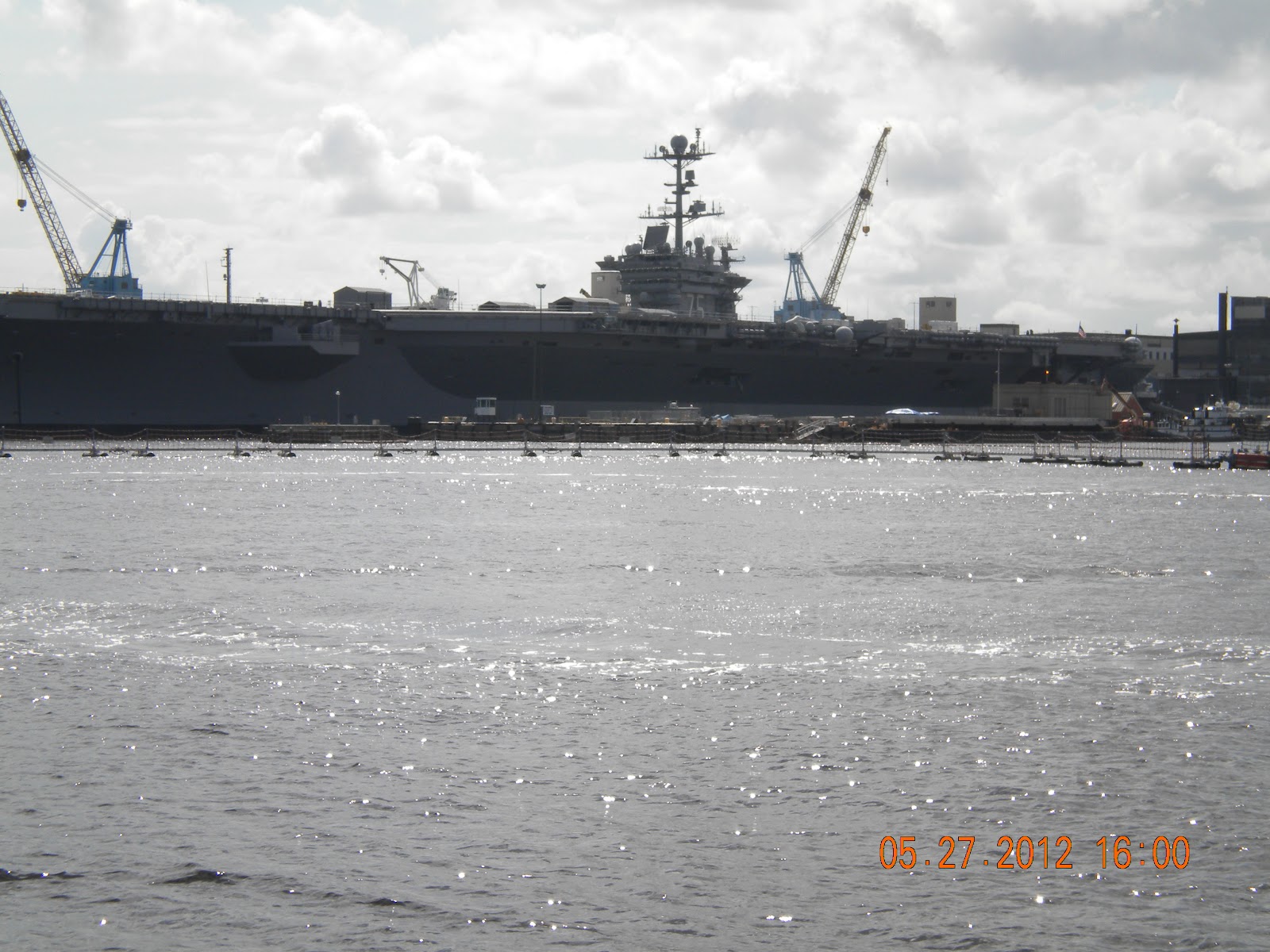
An aircraft carrier being repaired at Newport News.
I sure wouldn't want the bill for those repairs!!
When we initially pulled into the anchorage the wind was blowing out of the east at about 15 knots. We set our anchor accordingly, steering clear of the three other boats which had arrived before us. East was a good direction as far as the anchored boats were concerned, since we all had pretty good protection from Fort Monroe. About 2:30 AM, however, I heard waves thumping against the bow of the boat and decided I should see what was going on. Sometime during the night, apparently, the wind changed direction and picked up a little speed. We were now facing southwest – a direction from which there was very little protection – and the winds were about 20-25 knots. I decided I should stay in the pilothouse for the rest of the night to make sure we didn’t drag. We didn’t, but I sure was tired the next day.
We left Old Point Comfort about 7:30 bound for Deltaville, which would be Traveling Soul’s home for the next month. The boat needed a great deal of work (much of it deferred from when we first bought her) and Deltaville has become a cruisers destination both because of the quality of the work and the reasonable prices. Anyhow we hope that is the case.
ANN'S NOTES: This is the rainbow we saw in the Albemarle Sound in North Carolina. We had been following a weather front off our stern ...it seemed to be following us but never did catch up to us. I watched in amazement it how this rainbow changed before my eyes. I saw it add colored stripes and then fade away and then come back with two more. I could see where it started and ended from one point on land streching the beautiful ark across the water to the side of land. I must have watched the rainbow for a good half hour. Hey... if I can't have dolpins then I need some other type of magic to keep me busy.When I start talking about unicorns than you know I need some help :)

Our trip in the Dismal Swamp was interesting  and..S...L...O...W... I am glad we have done it and bought the t-shirt but I have no plans on doing it again. The canal in a strange way was beautiful..very green,lots of swamp sounds just like in the movies. Going into the locks was fun,to think that was a major improvement back in the day to move goods across the country, to me it was like a little time warp and a look back into our history. I was not that nervous about going in and out of the locks...I guess I did not know I was supposed to be nervous. As a line handler I  hand or toss lines to anyone that will take them and looks like they know what they are doing. Pretty simple...as the water comes into the lock, you take up the slack on the line; as water goes out of the lock, you let slack go to the line.

The visit with Lisa, Dave, Nik, Trent and Maddy was wonderful. I enjoy my family so very much. Having two 16 year old teenagers, it is great watching them turn into young adults. Trent is 12 and he spent the night with us on the boat. The time will come when he is driving and has a girlfriend and staying with Grandpa and Grandma will come in second place. I understand the older ones and, like them, I would want to spend some time with my friends before moving to California. Lisa drove me all over creation with a smile on her face, well not so much when we had to go into Wal-Mart. She HATES that place...actually it was Michael and Dave that needed a cable for the tv that made us go into THAT PLACE. We had dinner together every night and we have not done that in a long time. It was wonderful to have them around me and just do normal family stuff. The packers will be at her house on Tuesday, and the movers will be there on Wednesday. The kids last half day of school is on the 7th and, after that, they will be a few hundred miles away from Cherry Point NC.

So to end this trip on the ICW we did celebrate with lobster tail that we bought in Marsh Harbour...and I am now rationing... and steak. It is just a small part of the dream that we talked about when we were still living in a HOUSE on LAND. I am learning that dreams do come true but you also have to let other things go in order for that dream to happen. Not a sermon...just a thought.

This is my last wildlife count for awhile...

26 May 2012   1 Canadian goose and two babies....FYI ...that is the only Canadian we saw since leaving the Bahamas :)
1 Turtle             3 turtles on a log           4 turtles on a log...I think turtles are social sun bathers

27 May 2012         1 snake in the water...looking for that on lone turtle for lunch

28 May 2012   and yes.....drum roll ....please.... 1 Dolphin in the Chesapeake

Blessings to all of you,

Traveling Soul....OUT